
Marriage Compatibility in Vedic Astrology: Graha Maitri, the 7th Lord, Mangal Dosha, and Key Yogas
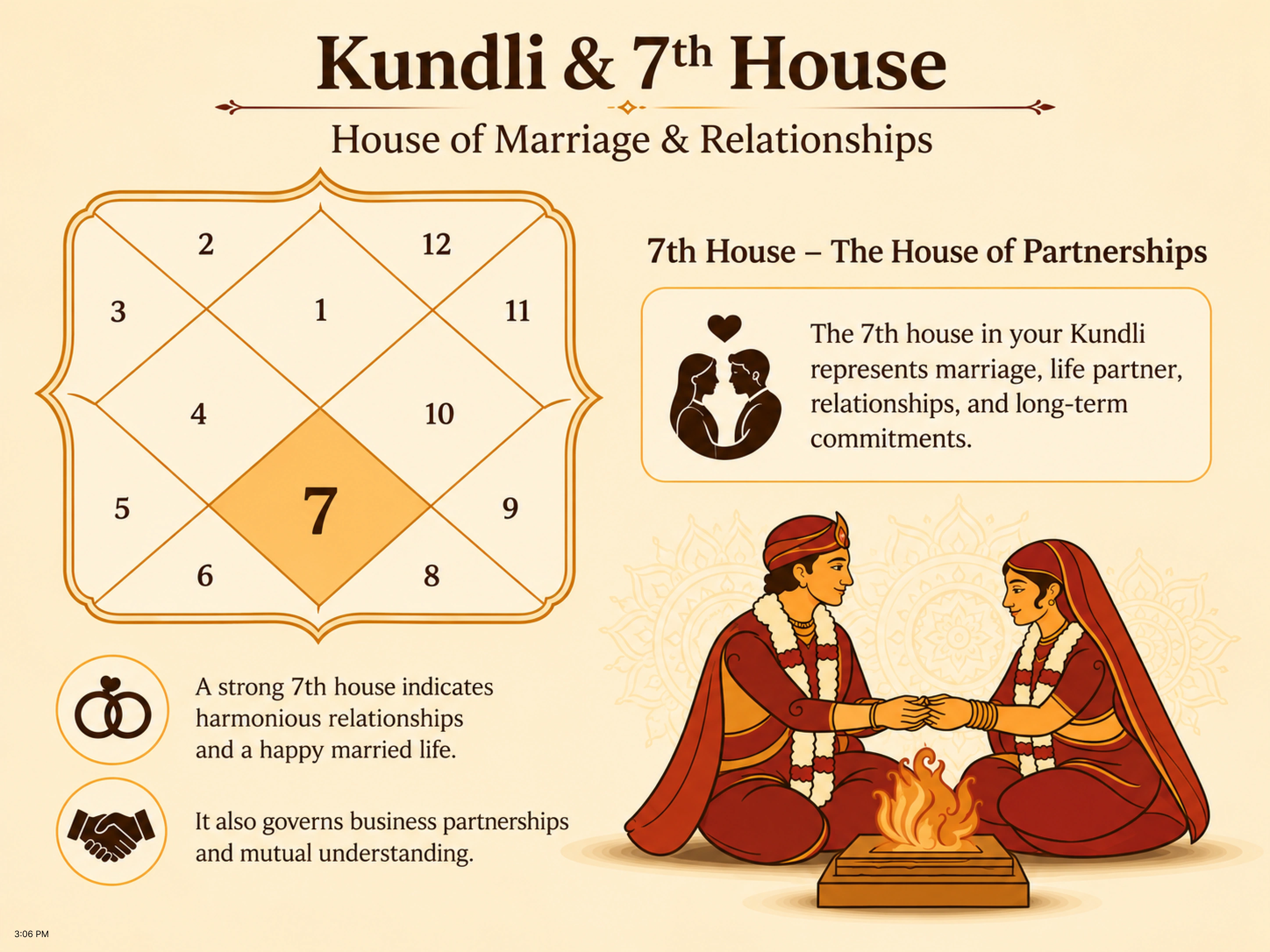
- Beyond Guna Milan: Compatibility rests on Graha Maitri (planetary friendship) between two charts, the 7th lord, Venus, and Navamsha, not just a score.
- The 7th Lord: Where the 7th lord sits decides the spouse's nature, marriage timing, and domestic happiness.
- Mangal Dosha: Mars in the 1st, 4th, 7th, 8th, or 12th house creates it — but many conditions cancel it.
- Marriage Timing: Jupiter transits, the Mahadasha of key lords, and Saturn's aspect on the 7th all point toward when marriage occurs.
- Love Marriage Yogas: Classical combinations of the 5th lord, 7th lord, Venus, and the nodes signal a love marriage.
Introduction
Matching two birth charts for marriage in Vedic astrology goes far beyond a simple Guna Milan score. A thorough analysis draws on planetary friendship between the two charts, the placement and condition of the 7th lord, Venus's sign and nakshatra, Mangal Dosha (and its cancellations), and a long list of classical yogas that indicate love marriage, divorce, widowhood, or lasting happiness. This post organises those principles into one reference guide.
Planetary Friendship Between Two Charts (Graha Maitri for Matching)
When comparing a prospective bride and groom's charts, astrologers look for these cross-chart connections:
- One person's ascendant should ideally fall in the other's 7th house.
- One person's 7th lord should ideally be placed in the other's 7th house.
- The bride's Moon should ideally fall in the same sign as the groom's 7th lord or Venus, and also in the same sign as the groom's 1st lord or Mars.
- The bride's Sun and the groom's Moon should ideally form a trine relationship.
- There should be harmony and auspicious combinations between the bride's 7th lord and the groom's ascendant lord.
- Both ascendants should ideally fall in mutual angles (kendra), trines (trikona), or gain houses (labha) from each other.
On the other hand, certain placements need extra care:
- Saturn in one chart should not occupy the same sign as the Sun and Moon in the other chart.
- The two ascendants should not fall in a Shadashtak (6/8) relationship with each other.
- Mars in Libra or Taurus should be examined especially carefully when assessing marital compatibility.
Some of the most auspicious cross-chart links involve the benefics:
| Connection | Why It Is Favourable |
|---|---|
| The Sun or Moon in one chart forms a trine (trikona) with Jupiter or Venus in the other | Links the two charts through the natural significators of fortune and love |
| Venus in one chart forms a trine, an auspicious combination, or a Nava-Pancham (9th/5th) with Mars in the other | Unites the planets of love and passion in harmony |
| The bride's Sun or ascendant lord is in an auspicious Nava-Pancham/Labha with the groom's ascendant | Joins the two ascendants through a benefic link |
| Angular (kendra) yogas formed from the angle houses | These have a particularly strong effect on marital happiness |
| The lord of an angle or a trine sits in the 7th house | Gives favourable, lasting results for the marriage |
Using the Navamsha Chart for Domestic Happiness
The Navamsha (D-9) chart reveals the inner picture of domestic life. When matching charts, astrologers weigh these points:
- Examine the trines of Dharma, Artha, Kama, and Moksha (houses 1/5/9, 2/6/10, 3/7/11, 4/8/12) and compare the likes and preferences of both individuals.
- Compare planetary friendship between the two charts, along with each person's health, financial standing, temperament, and longevity indicators.
- Check whether the bride's and groom's 7th lords fall in each other's "happiness" houses.
- Check whether the 7th lords of both charts are mutual friends or enemies.
- Consider indications for children and any chronic illness.
- Evaluate the physical compatibility of both individuals.
The wedding muhurta (auspicious time) itself matters too:
- Marriage should not occur within the same gotra (lineage) — sagotra marriage should be avoided.
- The wedding muhurta should ideally use a fixed ascendant and a fixed Navamsha; avoid a movable (chara) ascendant.
- It is favourable when Jupiter aspects the 7th house at the time of the muhurta.
- The sign occupying the 8th house for either the bride or groom should not become the ascendant at the time of marriage.
When Does Marriage Happen? (Timing Indicators)
Marriage timing is read through transits and dasha periods. Jupiter is the planet central to most of these indicators:
| Timing Indicator | What It Signals |
|---|---|
| Transiting Jupiter through the 1st, 2nd, 7th, 9th, 10th, or 11th house from the natal ascendant | A strong window for marriage |
| Transiting Jupiter aspects the 7th lord, ascendant lord, or Venus | Marriage yoga arises in the period |
| Transiting Jupiter aspects both the Moon and Venus (in a man's chart) | Marriage becomes likely |
| Transiting Jupiter aspects both the Sun and Mars (in a woman's chart) | Marriage becomes likely |
| Transiting Jupiter aspects the exact degree of the natal Sun (woman) / natal Moon or Venus (man) | A precise timing trigger |
Jupiter's transit should also always be checked from the Moon sign, not just the ascendant.
- When Saturn aspects the 7th house or 7th lord, marriage generally occurs around age 28–30.
- Jupiter in the 7th house typically indicates marriage after age 26; Mars in the 7th indicates marriage around age 28.
- Marriages are typically finalised during the Mahadasha of the ascendant lord, 7th lord, planets in the 7th house, the 5th lord, Venus, or the Moon.
- Any planet acting as the 7th lord placed in the 6th, 8th, or 12th house from the 7th house creates detachment from marriage.
- If the 7th lord is combust or retrograde, marriage indications may not appear clearly in some charts.
Also, in a woman's chart, the nakshatra and pada occupied by the natal Sun often indicate the likely first letter of the spouse's name.
Results of the 7th Lord by House Placement
The 7th lord is the single most important planet for the spouse itself. Where it sits changes the story of the marriage entirely:
| House of the 7th Lord | Result on Marriage |
|---|---|
| 1st house | Marriage to someone already known; if both the 7th lord and Venus are afflicted, the person tends toward excessive sensuality. |
| 2nd house (wealth) | Financial gain through marriage or through the spouse; if conjunct the 2nd lord, the wife is often employed. |
| 3rd house (valour) | If conjunct the 3rd lord, the spouse comes from a good family; this is also the "fortune house" from the 7th, but if afflicted, it can indicate infidelity. |
| 4th house (happiness) | The wife is virtuous, with gain of property and real estate; if with the 4th lord, the person travels extensively during the 7th lord's dasha. |
| 5th house | Early marriage, spouse from a good family; if conjunct the 5th lord, both wife and children turn out well. |
| 6th house | May indicate two marriages; afflicted 7th lord and Venus can suggest impotence or disease; other afflictions point to chronic illness or disrepute for the wife. |
| 7th house itself | With benefic planets, marriage happens early and the dasha runs favourably; with a malefic-linked 7th lord, married life is difficult. |
| 8th house | Risk of the spouse's death, accident, illness, or separation; the 8th lord's dasha tends to be difficult. |
| 9th house (fortune) | If conjunct the 9th lord, indicates pilgrimages, good reputation, and charitable acts. |
| 10th house | Good business results, a trustworthy spouse, mutual support in professional ventures. |
| 11th house (gains) | Possibility of more than one marriage, a wealthy spouse; if conjunct the 11th lord, excellent for partnerships and trade. |
| 12th house (expenses/loss) | If afflicted, indicates death, divorce, or living separately; some combinations see the native live abroad with the spouse. |
Venus by Sign: Effects on the Spouse
| Venus Sign | Effect on the Spouse |
|---|---|
| Aries / Scorpio Venus | Life marked by dishonour caused by the woman; if afflicted and placed in the 12th house, indicates an immoral lifestyle. |
| Taurus / Libra Venus | If unafflicted, the woman is good-natured and virtuous. |
| Virgo Venus | Indicates a lower-quality feminine disposition. |
| Gemini Venus | Indicates a sensual and hedonistic temperament. |
| Cancer Venus | Indicates lustfulness and a sickly constitution. |
| Leo Venus | The woman comes from a prominent family and carries herself with pride. |
| Sagittarius Venus | Indicates a happy domestic life. |
| Capricorn Venus | Indicates association with a woman of lower social standing. |
| Aquarius Venus | If not linked to malefic planets, indicates pure and virtuous conduct. |
| Pisces Venus | Indicates an excellent, happy married life. |
Mangal Dosha (Mars Affliction)
A chart is considered "Mangalik" (afflicted by Mars dosha) when Mars occupies the 1st, 4th, 7th, 8th, or 12th house from the ascendant.
When Mangal Dosha Is Cancelled
Not every Mars in these houses produces a full dosha. Many conditions cancel or soften it:
- Mars is debilitated (in Cancer).
- Mars is in an enemy's sign (Gemini or Virgo).
- Mars is combust (very close to the Sun).
- Mars is in Aries in the 1st, Scorpio in the 4th, Capricorn in the 7th, Leo in the 8th, or Sagittarius in the 12th — each is treated as a dosha-free placement.
- Mars receives full aspect from benefic planets, which softens its nature.
- If Saturn also occupies the 1st, 4th, 7th, 8th, or 12th house.
- If Saturn fully aspects the 7th house (from the 5th, 10th, or the ascendant itself).
- If a strong Jupiter or Venus is placed in the ascendant or 7th house, or fully aspects the 7th house.
- If Rahu or Ketu occupies the 1st or 7th house — this config makes the match unobjectionable.
Indicators of Love Marriage
A set of classical combinations points strongly toward a love marriage:
- Conjunction of the 5th lord and 7th lord.
- The 5th lord and 7th lord placed in a sign ruled by Venus.
- Venus placed in Taurus, Libra, Aries, or Scorpio (Venus's or Mars's signs).
- Venus placed in Pisces or Gemini, signs associated with romantic inclination.
- 5th lord in the 7th house: indicates a love marriage.
- 7th lord in the 5th house: indicates deep love for one's spouse.
- When the 8th house or 8th lord is afflicted by Rahu, Ketu, Saturn, or Mars (counted from the ascendant or the Moon), it often indicates an inter-caste marriage.
The modern outer planets also colour the romance reading:
| Combination | Effect on Romance |
|---|---|
| Venus in a trine or Nava-Pancham with Neptune | Highly emotional; raises the likelihood of a love marriage |
| Venus and Uranus in a first-rate favourable combination | Makes the person proactive in matters of romance |
| Venus and Uranus forming poor combinations | Commonly found in reckless or ill-considered love affairs |
| Uranus-Venus through the 1st and 5th houses | A strong cause of love marriage |
A Final Note
As with any single-factor reading in Vedic astrology, no planet's placement in the 7th house should be read in isolation. The final verdict on marital happiness always depends on the complete chart, the strength of the 7th lord, the condition of Venus and Jupiter as natural significators of marriage, the Navamsha (D-9) chart, and the dasha periods running at relevant points in life. Treat this guide as a starting point for understanding planetary tendencies, not as a final prediction.
If you or someone you know is preparing for marriage and wants a detailed compatibility analysis of two Kundlis, connect with Astrochitra today for expert astrological guidance and Kundli matching.
Comments
Related Articles
Auspicious Yogas for Marriage in Vedic Astrology
The 7th House and Marriage: What Each Planet Reveals About Your Love Life

Chandra Mangal Yoga: Meaning, Benefits & Effects
Learn about Chandra Mangal Yoga in Vedic Astrology, its formation, benefits, effects on wealth, courage, success, negative combinations, and remedies.