
How to Read Your Kundli
Learn how to read your kundli in Vedic astrology: the house lord first, then occupants, aspects and karaka, with a worked example.

- A house is read in five checks: the house itself, its lord, its occupants, its aspects and its karaka (natural significator). The lord carries the most weight.
- The sign on a house tells you which planet rules it. That planet's placement decides where the house's affairs are carried.
- A planet sitting in a house modifies the house. It does not replace the lord.
- Aspects show who else influences the house, and they must be checked on both the house and its lord. Saturn, Jupiter and Mars have special aspects that matter.
- The karaka is a cross-check. It gives the generic theme, while the lord gives your specific version of it.
- Strength decides the quality of a house. A strong house can still stay quiet until its lord's dasha (planetary period) or a transit from your Moon sign activates it.
The short answer: Read a house in five checks. The house itself sets the field. The sign on it gives its lord, and the lord's position sets the theme. The planets inside modify it. Aspects and the karaka qualify it. The lord carries the most weight. Here is how to apply that order to your own kundli.
The situation
- You have probably been told two opposite things about the same area of your life. One reading says it is strong. Another says it is blocked.
- Both readings quote a placement. Neither explains how the conclusion was reached.
- That is the real problem: not a missing prediction, but a missing method.
- Once you know the order in which a house is read, most of the contradiction disappears. The chart has not changed. You are simply looking at the right factor first.
- This post gives you that order, a worked example, and a worksheet you can fill in for your own chart.
Before you start: what to keep open
- Your kundli (the main birth chart). You need the sign on every house and the house every planet sits in.
- Your exact birth time. The Lagna (rising sign) changes roughly every two hours, and every house shifts with it. If you are unsure which sign is rising, start with Lagna, Moon sign and Sun sign.
- Your dasha list. You will need it in the timing section further down.
- About fifteen minutes, and one house. Pick the area of life you care about most.
The five checks at a glance
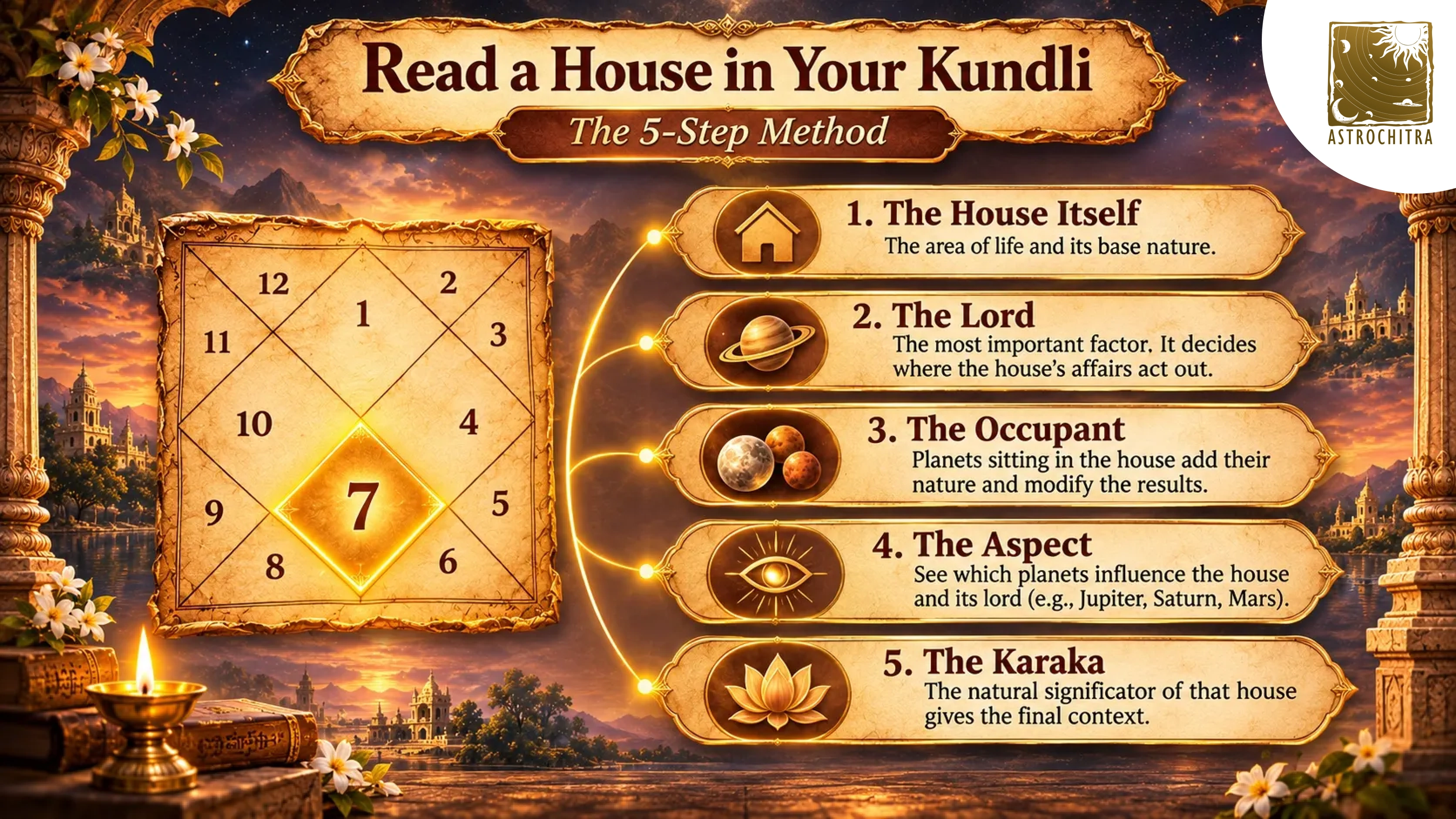
| Step | What you look at | The question it answers | What changes the reading |
|---|---|---|---|
| 1. House | The sign on the house | Which area of life is this, and which planet rules it? | The sign sets the lord. The house number sets the domain. |
| 2. Lord | The house, sign and condition of the ruling planet | Where do this house's affairs travel? | Dignity, combustion, retrograde motion and the houses it rules. |
| 3. Occupant | Planets sitting in the house | What is added, delayed or obstructed? | The occupant's nature and strength. A benefic helps, but it does not replace a weak lord. |
| 4. Aspect | Planets aspecting the house or its lord | Who else influences this area? | Aspect type and strength. Saturn, Jupiter and Mars have special aspects. |
| 5. Karaka | The natural significator of the house | What is the generic theme? | The karaka's placement and strength. It supports the lord; it does not replace it. |
Quick glossary
| Term | Plain meaning |
|---|---|
| Bhava (house) | One of twelve fixed areas of life, counted from the Lagna. |
| Lagna | The sign rising on the eastern horizon at birth. It is the first house. |
| House lord (bhavesha) | The planet that rules the sign sitting on a house. |
| Occupant | Any planet physically placed in the house. |
| Aspect (drishti) | The influence a planet casts on a house, counted in houses from where it sits. |
| Karaka | The natural significator: the planet that stands for a theme in every chart. |
| Dignity | How comfortable a planet is in its sign: own, exalted, friendly, neutral, enemy or debilitated. |
| Combust | Too close to the Sun, which dims the planet's results. |
| Retrograde | Appearing to move backward from Earth. It changes the manner of results, not simply their quality. |
| Kendra / Trikona / Dusthana | Angle houses (1, 4, 7, 10), trine houses (1, 5, 9) and difficult houses (6, 8, 12). |
| Mahadasha / Antardasha | The long planetary period and the sub-period inside it. They are the timing clock. |

Check 1: The house itself
What this check does: it fixes the field of life you are reading.
- A house is a fixed area of life. The first is the body and direction of the chart, the seventh is partnership, the tenth is work and public standing.
- The house number never changes. What changes from chart to chart is the sign sitting on it.
- The sign gives the house its lord. That single link is how every house connects to the rest of the chart.
- Count houses from the Lagna: the Lagna sign is the first house, the next sign is the second, and so on around the wheel.
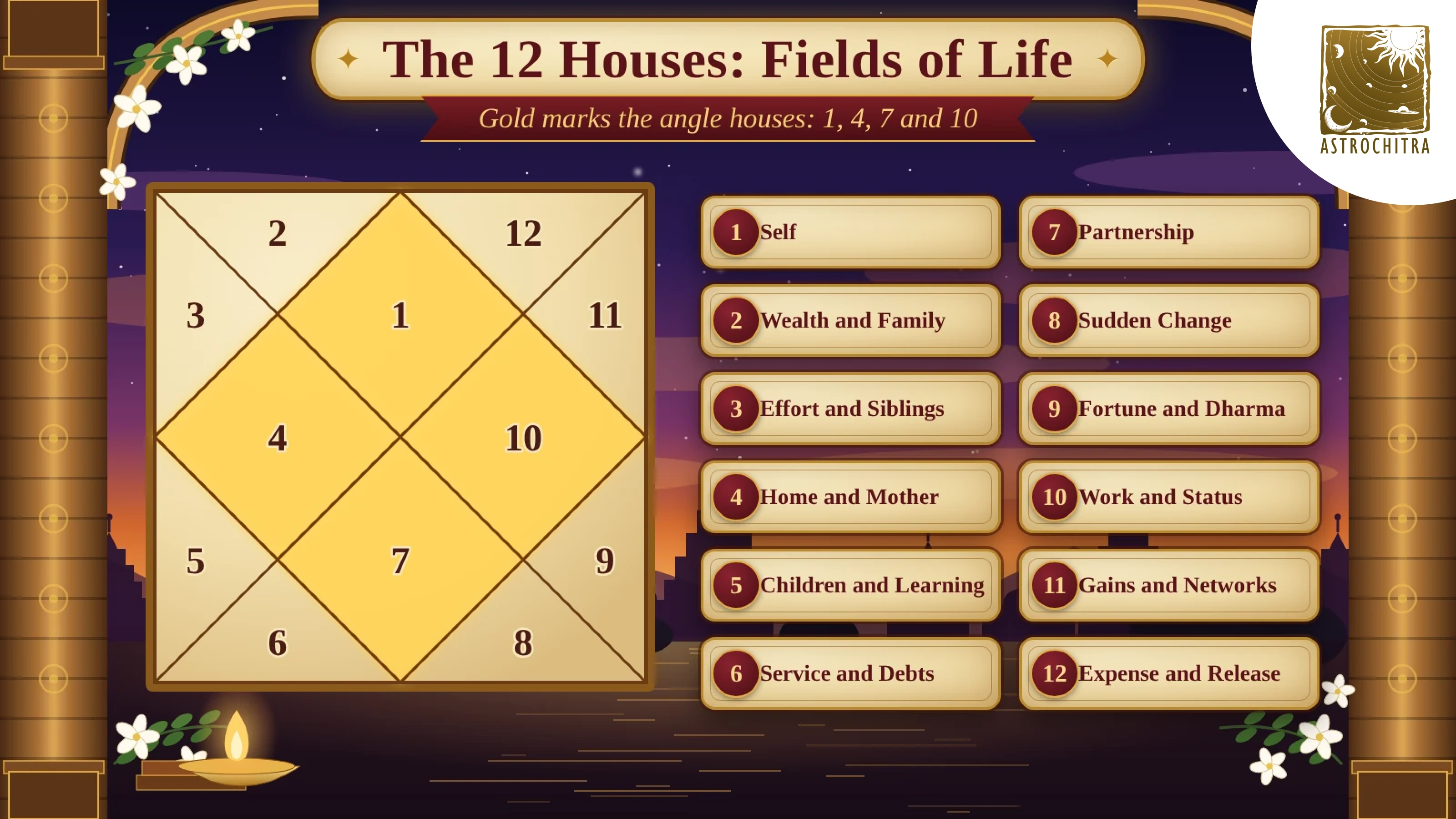
| House | Type | Main domain |
|---|---|---|
| 1st | Kendra, trikona | Self, body, character and direction |
| 2nd | Neutral | Family, speech, food and stored wealth |
| 3rd | Neutral | Effort, courage, skills, siblings and short travel |
| 4th | Kendra | Home, mother, property and emotional security |
| 5th | Trikona | Children, learning, creativity and earned merit |
| 6th | Dusthana | Service, competition, debts and daily discipline |
| 7th | Kendra | Spouse, partnerships, contracts and open dealings |
| 8th | Dusthana | Sudden change, transformation, shared resources and hidden matters |
| 9th | Trikona | Fortune, teachers, dharma and long journeys |
| 10th | Kendra | Work, status and public action |
| 11th | Neutral | Gains, networks and fulfilment of wishes |
| 12th | Dusthana | Expense, release, sleep and foreign lands |
Finding the lord from the sign
- Look at the sign number or name on your chosen house.
- Use the table below to find the planet that rules that sign. That planet is the house lord.
- Two signs belong to each planet except the Sun and Moon, so most planets will rule two houses in your chart. Note both.
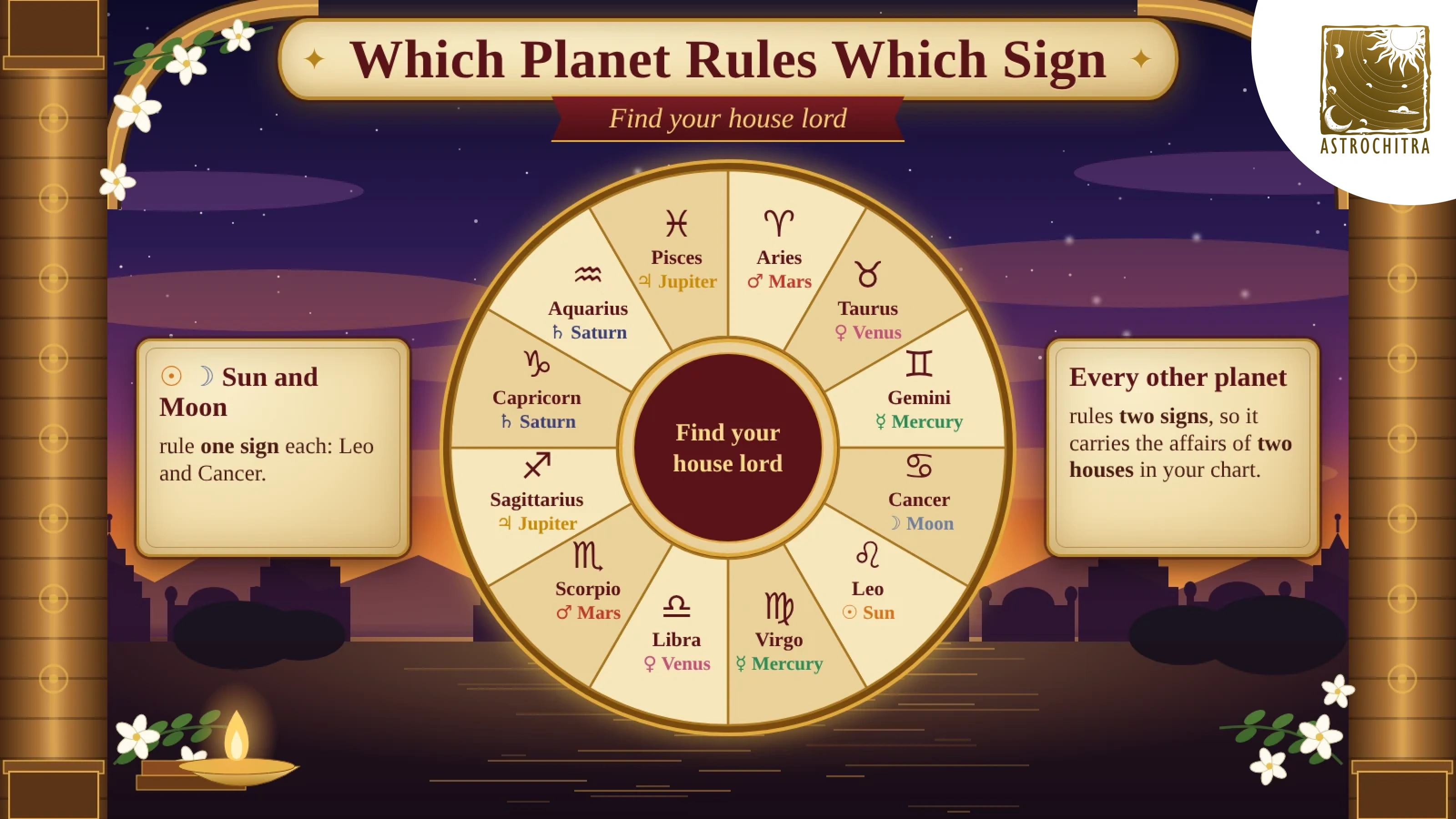
| Sign | Lord | Sign | Lord |
|---|---|---|---|
| Aries | Mars | Libra | Venus |
| Taurus | Venus | Scorpio | Mars |
| Gemini | Mercury | Sagittarius | Jupiter |
| Cancer | Moon | Capricorn | Saturn |
| Leo | Sun | Aquarius | Saturn |
| Virgo | Mercury | Pisces | Jupiter |
Some traditions also give Rahu and Ketu a share in Aquarius and Scorpio. This post uses the seven classical planets, which is the simpler and more common starting point.

Check 2: The lord
What this check does: it shows where the house's affairs travel. This is the most important factor.
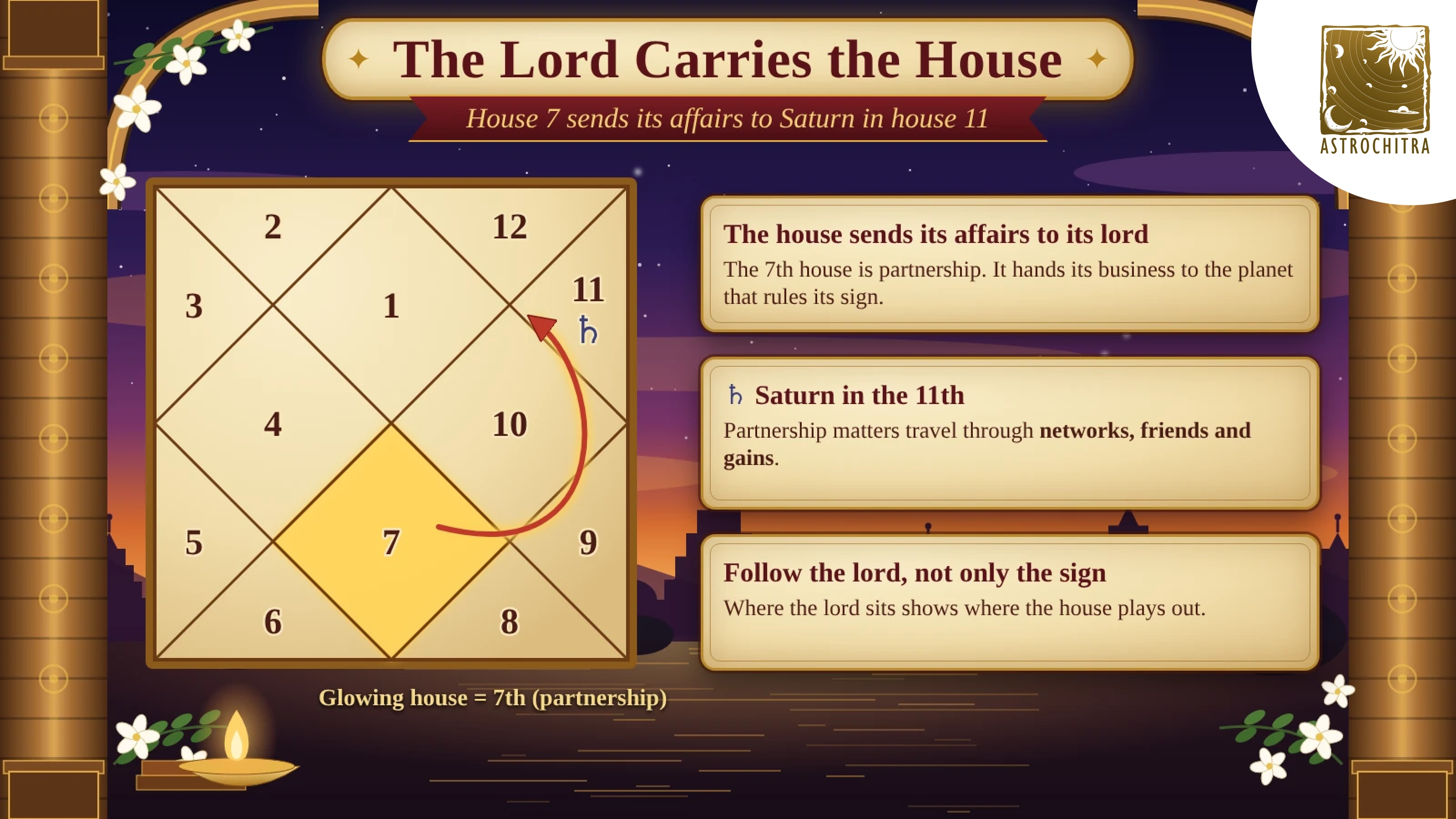
- Start with the lord. If the seventh house is Aquarius, Saturn rules it.
- Where Saturn sits shows where partnership matters travel. Saturn in the eleventh routes partnership through networks, friends or community. Saturn in the sixth routes it through work, service or delay.
- The lord carries the house's business into another part of the chart. This is why two people with the same seventh sign can have very different partnership stories.
- Always note the other house the lord rules. A planet rules two signs, so it carries two sets of affairs.
Where the lord sits: a simplified reading aid
Count the house the lord occupies from the Lagna. Chapter 24 of the Brihat Parashara Hora Sastra (BPHS) gives detailed results for every combination of house lord and placement. The table below is only a short summary of the routes.
| Lord sits in | The house's affairs tend to travel through |
|---|---|
| 1st | You personally. The matter is tied closely to your own effort and identity. |
| 2nd | Family, speech and resources. |
| 3rd | Effort, communication, siblings and skill. |
| 4th | Home, comfort and emotional base. |
| 5th | Learning, creativity, children and earned merit. |
| 6th | Service, competition, health upkeep and delay. |
| 7th | Other people, partners and open dealings. |
| 8th | Hidden, sudden or transformative routes. |
| 9th | Fortune, teachers, belief and travel. |
| 10th | Career, public action and responsibility. |
| 11th | Networks, friends and gains. |
| 12th | Expense, distance, solitude or release. |
How strong is the lord?
Strength qualifies everything. The same placement reads very differently depending on the lord's condition.
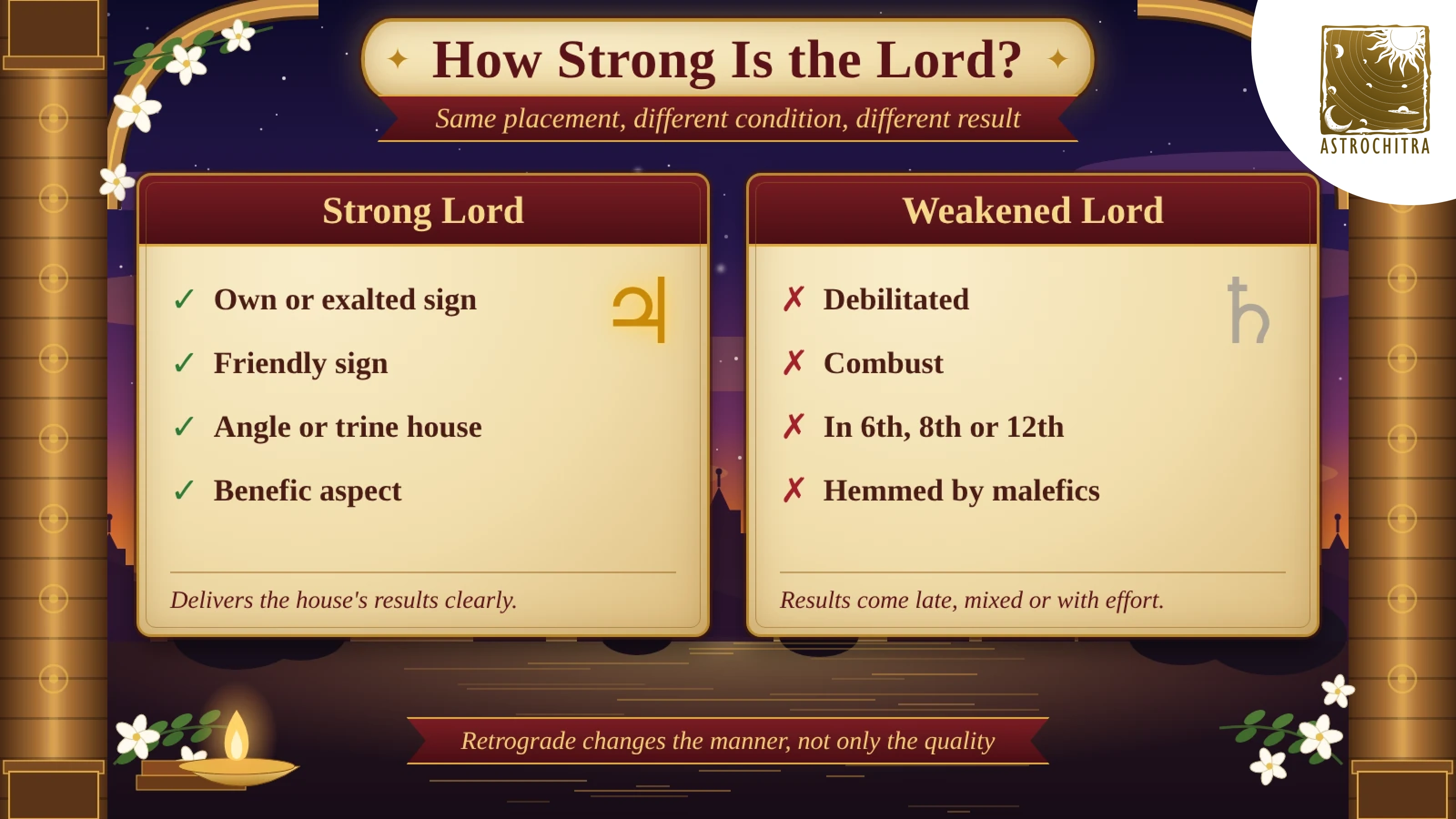
Signs that support a lord
- It sits in its own sign or its exaltation sign.
- It sits in a friendly sign.
- It sits in an angle (1, 4, 7, 10) or a trine (1, 5, 9) from the Lagna.
- It is aspected by Jupiter or another well-placed benefic.
Signs that weaken a lord
- It is debilitated (fallen into its weakest sign) with no cancellation.
- It is combust, too close to the Sun.
- It sits in a difficult house (6, 8, 12) and is not otherwise supported.
- It is hemmed in by malefic influence with no relief.
Retrograde is different. It does not simply mean weak. A retrograde lord tends to deliver results in a more internal, repeated or delayed way, and classical texts treat the motion as a factor of strength as well as a complication.
- A weak lord does not make a house permanently bad. It changes the quality and the timing.
- A benefic occupant can soften a weak lord. It cannot replace it.

Check 3: The occupant
What this check does: it shows what is added, delayed or obstructed inside the house.
- A planet in the house adds its own nature to the area. The Moon in the seventh adds an emotional need for company. Saturn in the seventh adds caution and a slower pace.
- Occupants modify the house. They do not overrule the lord.
- Check the occupant's own strength first, then check which houses it rules. An occupant that is also a lord brings that second house's affairs into this one.
- An empty house is not a weak house. Its lord can do all the work.
| Occupant | Tends to add to the house |
|---|---|
| Sun | Authority, pride, a strong sense of self and a need for recognition. |
| Moon | Emotional sensitivity, a need for care and changing moods. |
| Mars | Drive, speed, courage and friction. |
| Mercury | Talk, analysis, trade and quick adaptation. |
| Jupiter | Growth, protection, guidance and a wider view. |
| Venus | Harmony, attraction, comfort and a wish for beauty. |
| Saturn | Caution, delay, responsibility and slow maturing. |
| Rahu / Ketu | Rahu intensifies and pulls toward the unconventional. Ketu detaches and withdraws. |
- Jupiter, Venus, a well-placed Mercury and a waxing Moon are generally treated as benefics.
- Saturn, Mars, the Sun, Rahu and Ketu are generally treated as malefics. Malefic does not mean harmful. It means the planet's help comes through pressure and effort.
- A benefic usually helps. A malefic usually tests. Neither changes who the lord is.

Check 4: The aspect
What this check does: it shows who else influences the area.
- A planet influences the house it sees, and it also influences any lord sitting in a house it sees.
- Check both targets: the house itself and the house lord.
- Count in houses, and count your own house as the first. Jupiter in the eleventh reaches the seventh by its ninth aspect: eleventh, twelfth, first, second, third, fourth, fifth, sixth, seventh.
- Jupiter's aspect tends to support. Saturn's tends to compress and mature. Mars adds friction or drive.
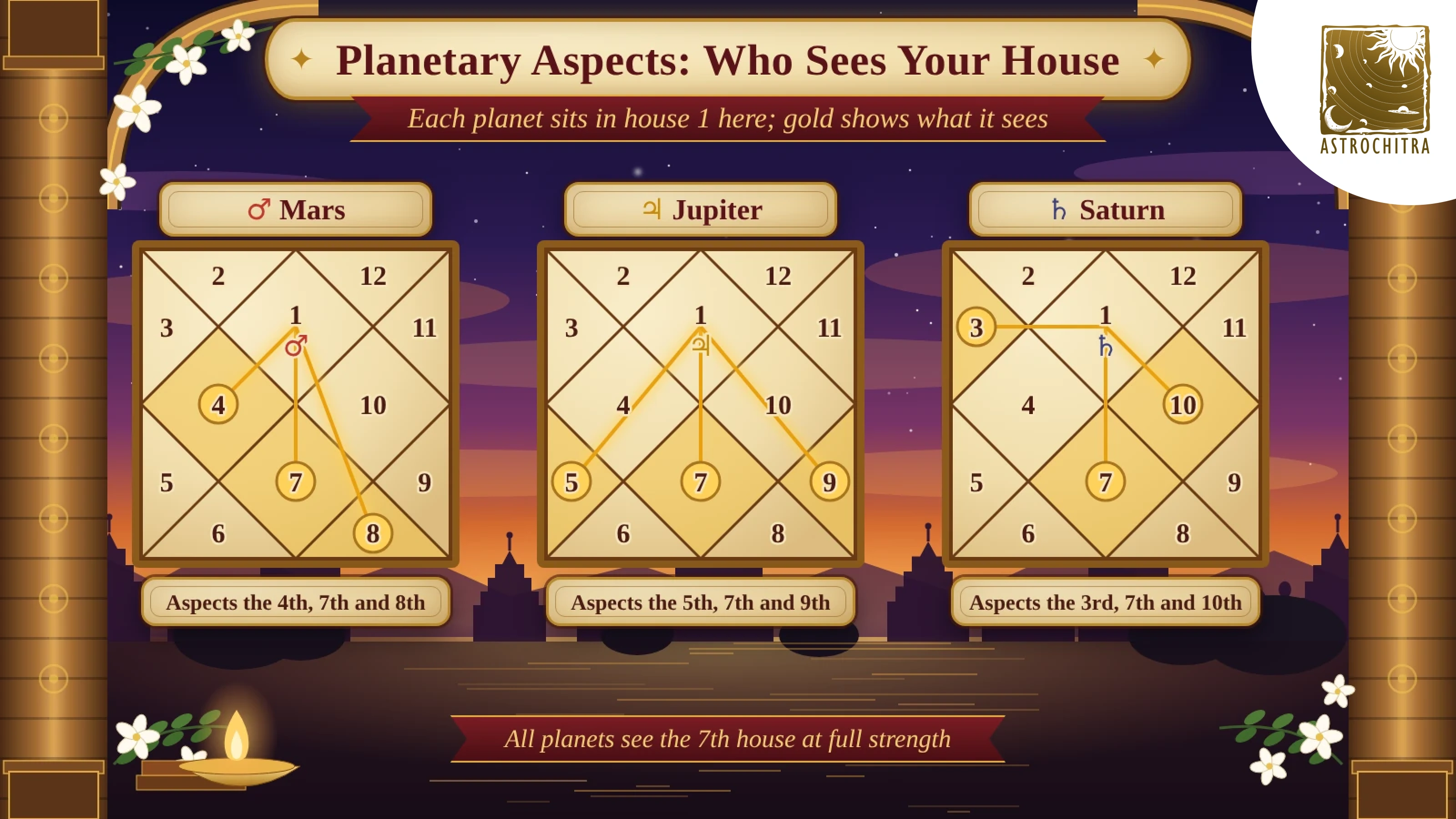
| Planet | Houses aspected from where it sits |
|---|---|
| All planets | 7th (full strength) |
| Mars | 4th, 7th, 8th |
| Jupiter | 5th, 7th, 9th |
| Saturn | 3rd, 7th, 10th |
Traditions differ on the aspects of Rahu and Ketu, so this post does not rely on them.
- Chapter 26 of BPHS treats aspect strength as graded, not a yes-or-no switch. In the commonly taught scheme the 3rd and 10th aspects act at about a quarter strength, the 5th and 9th at about half, the 4th and 8th at about three quarters, and the 7th at full strength.
- The special aspects of Mars, Jupiter and Saturn are the ones that reach full strength beyond the 7th.
- An aspect from a malefic with no support makes a house harder. An aspect from a strong benefic eases it. Both can be true of the same house.

Check 5: The karaka
What this check does: it gives the generic theme of the house.
- The karaka is the natural significator. Venus stands for partnership and union in every chart. Jupiter stands for children, fortune and gains.
- The karaka gives the generic theme. The lord gives your specific version of it.
- Check the karaka's own placement and strength. A strong karaka supports the house even when the lord is average.
- When the lord and the karaka agree, the reading is cleaner. When they disagree, the lord usually carries more weight.
The primary karaka for each house, following chapter 32 of BPHS, is a useful cross-check:
| House | Primary karaka | Also commonly listed | What it adds |
|---|---|---|---|
| 1st | Sun | — | Self, vitality and direction |
| 2nd | Jupiter | — | Stored wealth, family and speech |
| 3rd | Mars | — | Effort, courage and siblings |
| 4th | Moon | Mercury | Home, mother and emotional security |
| 5th | Jupiter | — | Children, learning and creativity |
| 6th | Mars | Saturn | Service, competition and daily discipline |
| 7th | Venus | — | Partnership and union |
| 8th | Saturn | — | Sudden change and shared resources |
| 9th | Jupiter | Sun | Fortune, teachers and dharma |
| 10th | Mercury | Jupiter, Sun, Saturn | Work, trade and public dealings |
| 11th | Jupiter | — | Gains and networks |
| 12th | Saturn | — | Expense, release and foreign lands |
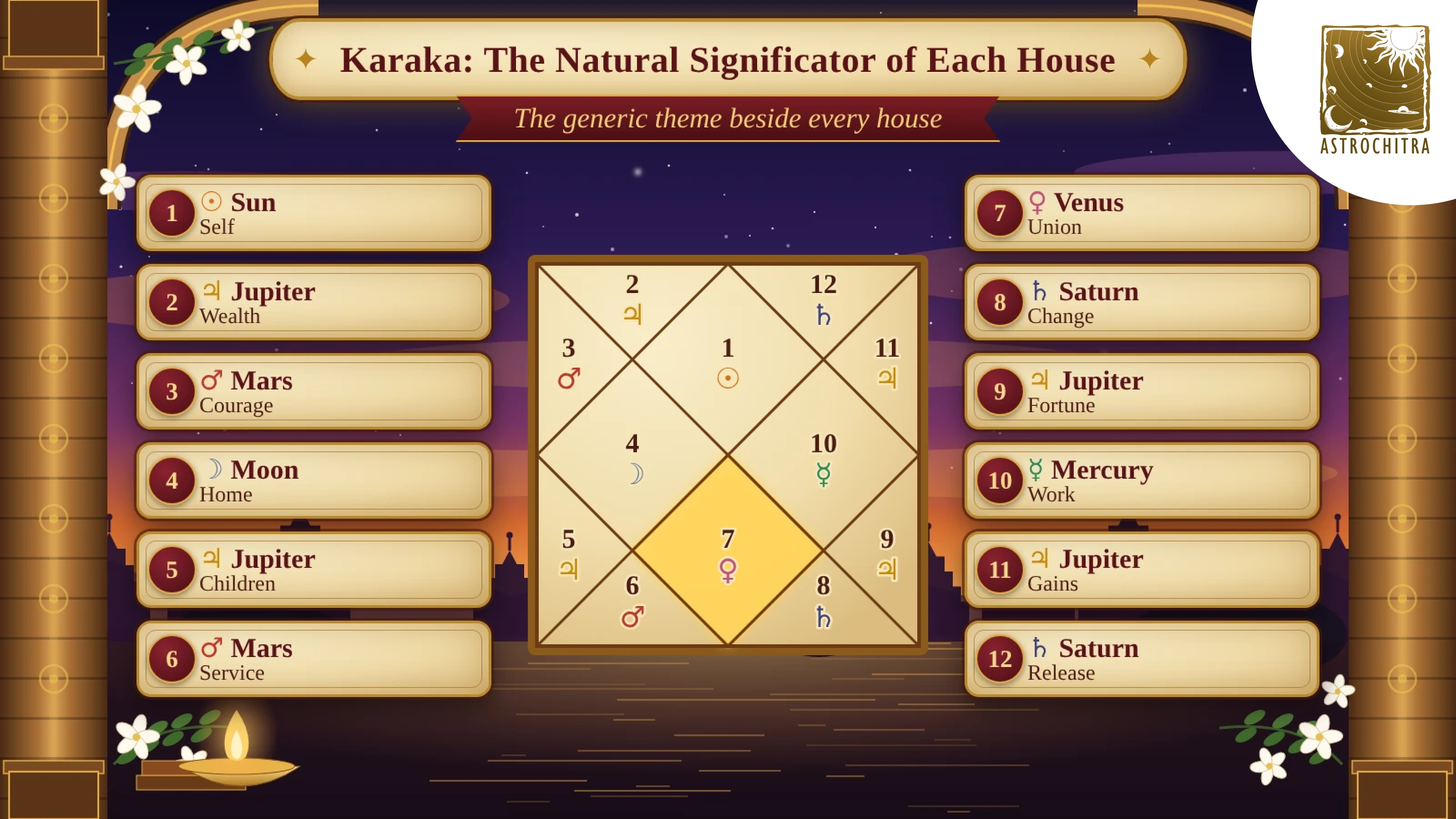
Treat the table as the first check, not the only one. BPHS cautions that a house signifies more than its listed karaka, so the right significator can change with the question you are asking. Older manuals do not always agree on the list, which is another reason to read the lord first and use the karaka as a cross-check.
When this switches on

A house can be well described and still silent.
- The description tells you what the area is like.
- The clock tells you when it becomes active.
- Three clocks work together: the mahadasha, the antardasha and transit.
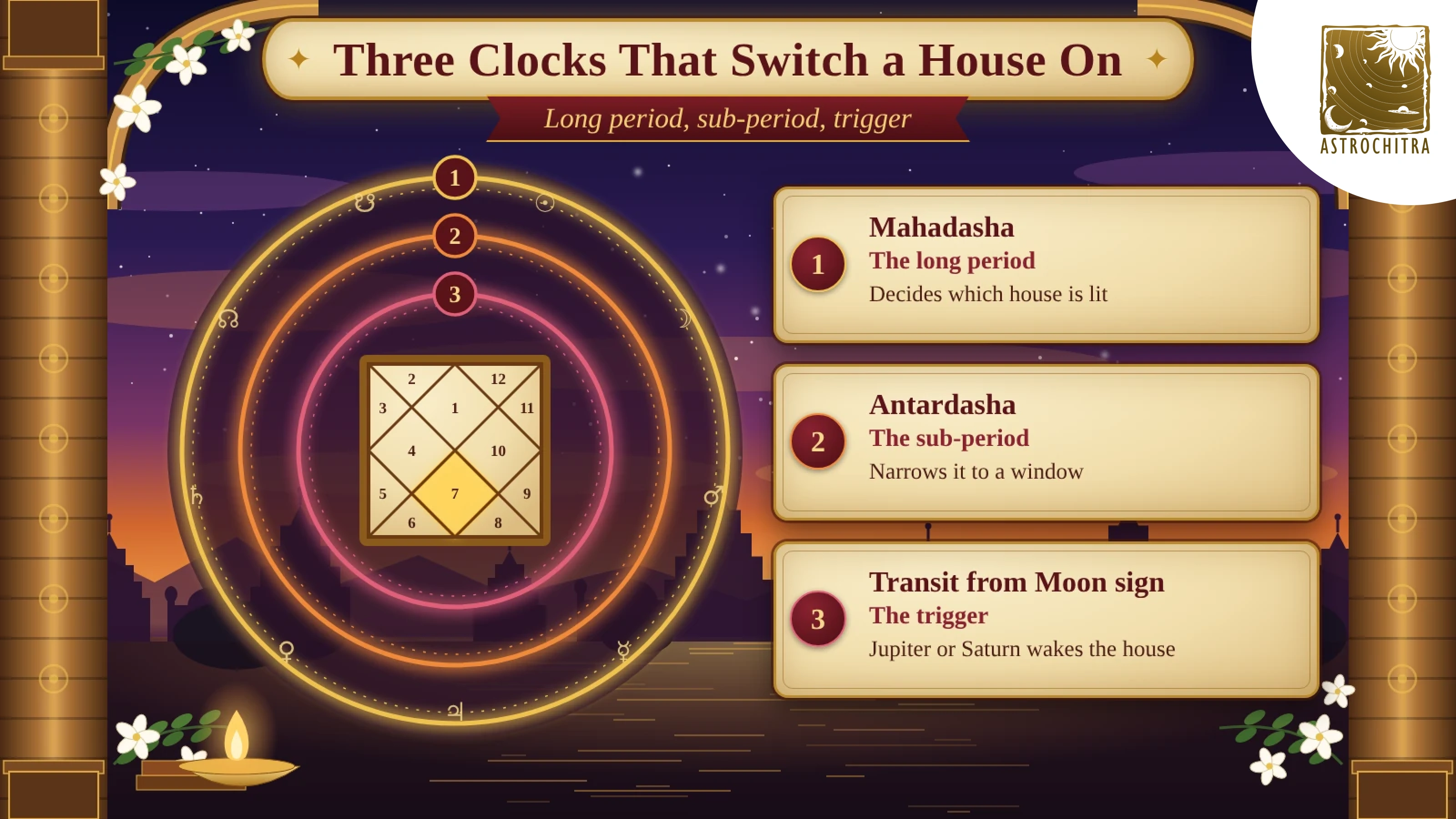
| Clock | What it is | What it does for the house |
|---|---|---|
| 1. Mahadasha | The long planetary period | A house's affairs tend to become visible when the dasha of its lord, its occupant or its karaka is running. A Saturn period puts partnership on the table if Saturn is the seventh lord. It does not guarantee a marriage. It makes the topic live. |
| 2. Antardasha | The sub-period inside the long period | This is where timing becomes specific enough to notice. A Saturn mahadasha may run for nineteen years. The sub-period of Venus, the seventh karaka, is a smaller window inside it. That is the window you watch. |
| 3. Transit | Planets moving through the signs now, counted from your Moon sign | Jupiter or Saturn moving through the sign that falls in that house from your Moon, or aspecting its lord, is the classical trigger. A transit activates what the dasha has already made available. During an unrelated period it often passes without a visible change. |
What weakens the reading
- A lord that is combust, debilitated without cancellation or placed in a difficult house.
- An occupant that is itself weak.
- An aspect from a malefic with no support.
- A transit through a sign with a low ashtakavarga score (a transit-strength score).
None of these makes the house permanently inactive. They change the quality and the timing. If you want the wider logic of house lords and karma, read how bhagya and karma works.
A worked example
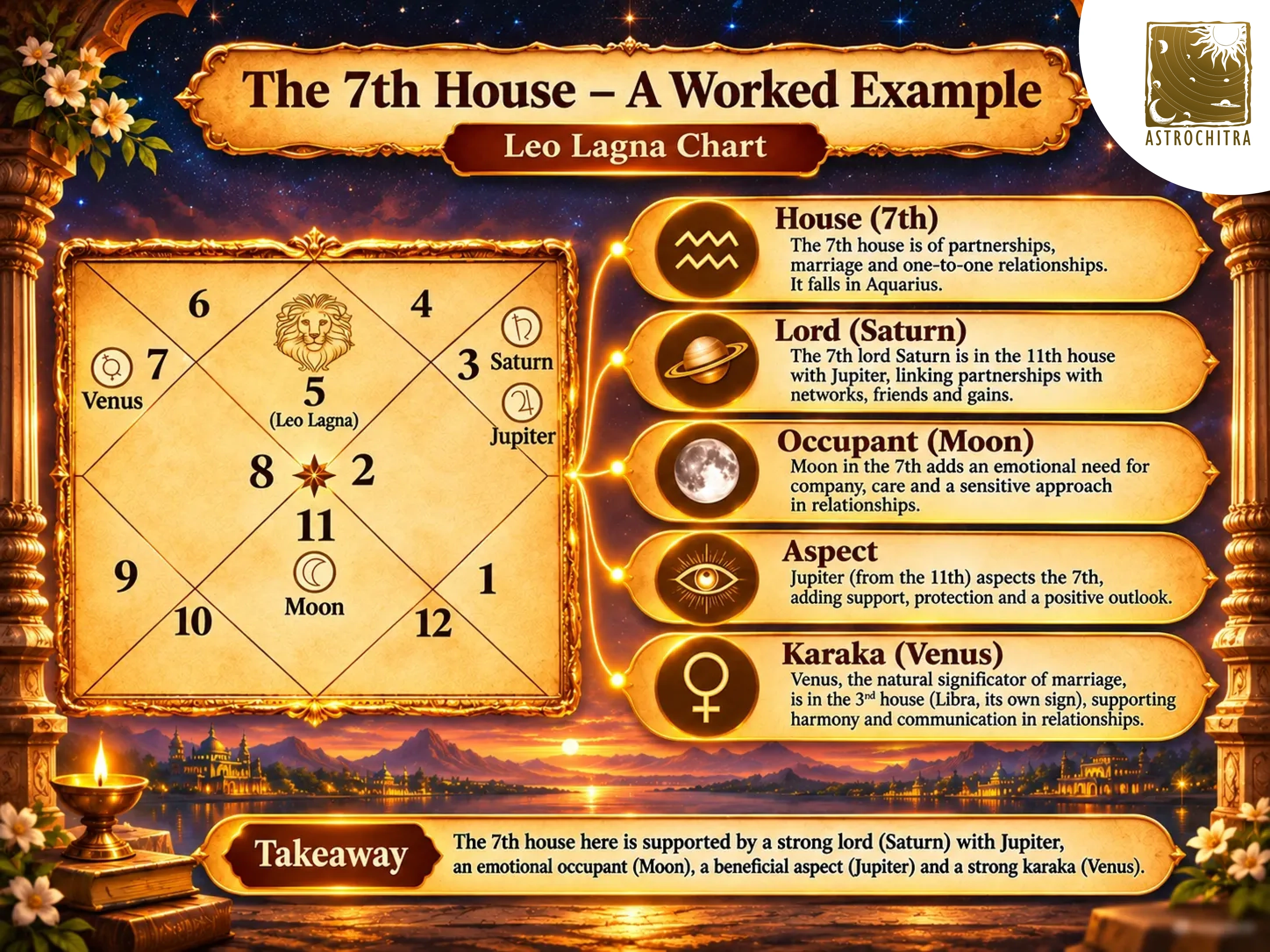
Here is a composite chart, not a client's chart. It is simplified to show the order, not to demonstrate a full reading.
The chart
- Lagna is Leo. The seventh house is Aquarius, ruled by Saturn.
- Saturn sits in the eleventh house, Gemini, with Jupiter.
- The Moon sits in the seventh house, Aquarius.
- Venus, the seventh karaka, sits in the third house, Libra, in its own sign.
Read it in order
1. House: the seventh governs partnership.
- It falls in Aquarius, so Saturn is the lord.
- Saturn also rules Capricorn, which is the sixth house in this chart. Partnership matters therefore also touch service, effort and the work of maintaining things.
2. Lord: Saturn in the eleventh sends partnership matters through networks, friends, community and gains from working with others.
- Saturn is in Gemini, a friendly sign because Mercury is Saturn's friend, but not its own sign. The route is workable, not effortless.
- The eleventh is not a difficult house, so Saturn is placed in a supportive position.
3. Occupant: the Moon in the seventh adds a strong emotional need for company.
- The Moon in Aquarius also wants space and friendship inside the relationship.
- For a Leo Lagna, the Moon rules the twelfth house. That brings a thread of privacy, distance or retreat into the partnership.
4. Aspect: Jupiter in the eleventh aspects the seventh by its ninth aspect, one of the special aspects BPHS gives Jupiter.
- Jupiter supports the house, but it is conjunct Saturn, so the support is structured and slow rather than dramatic.
- Jupiter rules the fifth and the eighth for Leo Lagna, so it brings learning and goodwill, and also a thread of depth and change.
5. Karaka: Venus in the third, in Libra, is strong.
- Communication, writing, short travel or a sibling or neighbour connection may be part of how partnership arrives.
- Venus also rules the tenth for Leo Lagna, so work and public life can be a meeting ground.
Put together: partnership is likely to arrive through a network or community, with an emotional need for space, and with communication playing a visible role. The chart does not give a date. It gives a route and a set of conditions.
What to watch in the timing
- A Saturn mahadasha puts the topic on the table. Saturn is the seventh lord.
- A Venus antardasha inside it is the sharper window. Venus is the karaka.
- A Jupiter transit that touches the seventh from the Moon, or aspects Saturn, can act as the trigger.
For a partnership-specific reading, see where will you meet your life partner. For the full range of seventh-house meanings, see the 7th house and marriage.
Your turn: the five-check worksheet
Pick one house and fill in one row per check. Do this once, slowly, and you will stop reading a single planet as the whole story.
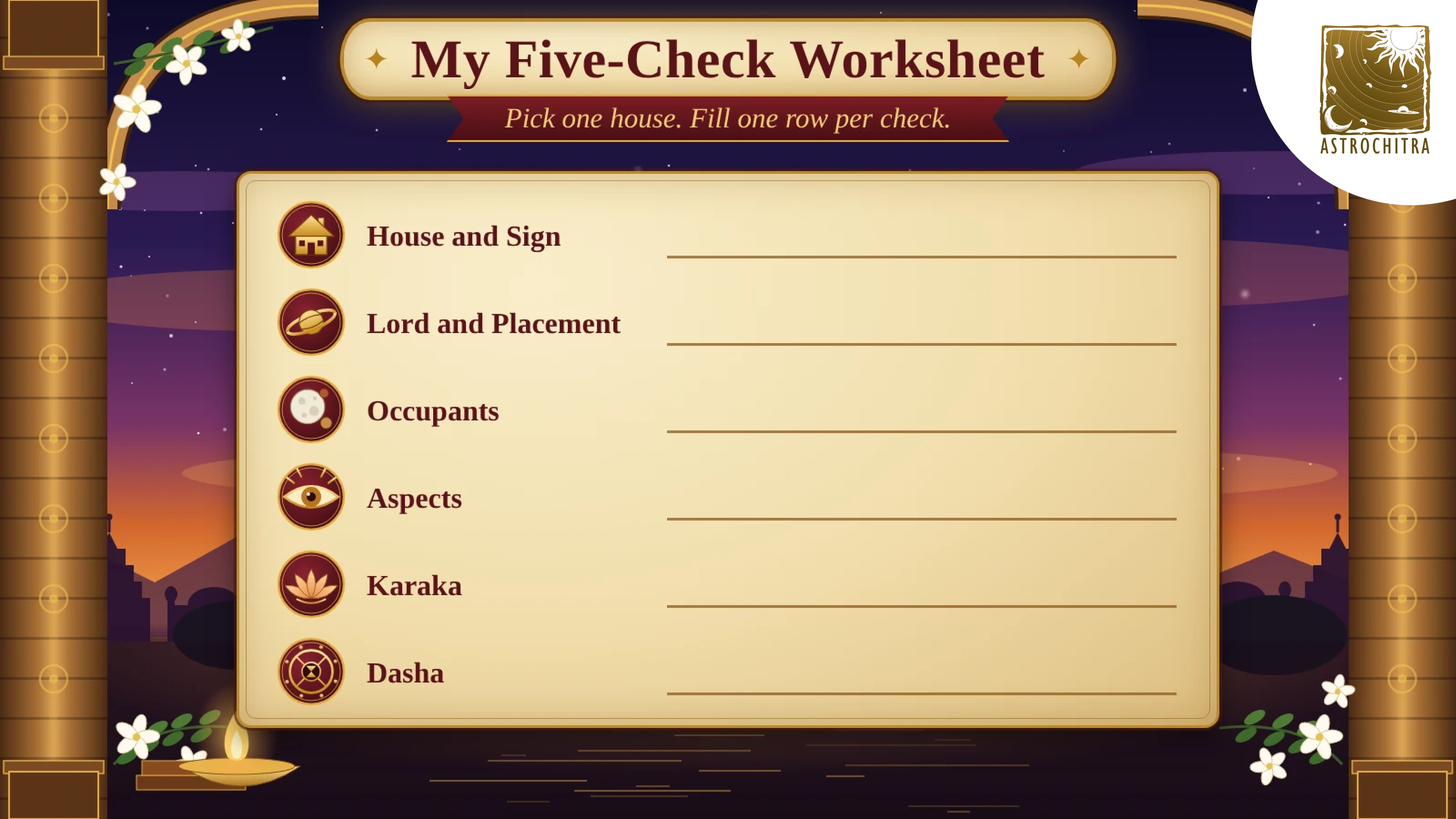
- House and sign: write the house number and the sign on it.
- Lord: write the planet that rules the sign, the house it sits in and its condition. Add the other house it rules.
- Occupants: list every planet in the house, and note the houses each one rules.
- Aspects: list every planet that aspects the house, then every planet that aspects the lord.
- Karaka: find the karaka in the table above and note its house and condition.
- Timing: write down the running mahadasha and antardasha, and note whether they belong to the lord, an occupant or the karaka.
Use the result to ask a better question. Instead of "Is my seventh house good?", ask "Where does my seventh lord sit, and which period is running?" That question has an answer you can check.
Common mistakes
- Reading the occupant first. The lord comes first. The occupant modifies the story.
- Calling an empty house weak. A house with no planets can be strong if its lord is strong.
- Forgetting the second house a lord rules. Every planet except the Sun and Moon rules two houses.
- Treating the karaka as the lord. The karaka is a cross-check, not a replacement.
- Reading aspects only on the house. Check the lord too.
- Treating a good placement as a date. A house describes a field. The dasha and transit decide when it moves.
- Counting transits from the Lagna. The timing method here counts from the Moon sign.
- Using an uncertain birth time. A small error can change the Lagna and every house with it.
What it tends to feel like
- When a house activates, it rarely announces itself with a single event.
- It feels like a topic keeps returning. A conversation you had written off reopens. A decision you were avoiding becomes harder to postpone.
- The area becomes visible, and you notice how much of your attention it already had.
- What does not change automatically is the underlying pattern. A good window widens the opening. It does not make the choice for you.
- If the lord is weak, the period may bring the topic without the resolution. That is still useful information. It tells you where to put your effort, not what to expect.
What you can actually do
- Pick one house and complete the worksheet above. Do not read a second house until the first is done.
- Replace verdict questions with route questions. Ask where the lord sits and which period is running.
- Keep a short note of what the house has meant in your life so far, then compare it with the chart. Your own history is the best check on a reading.
- If you are working through the beginner path in order, the Start Here index collects these posts.
On remedies, BPHS chapter 84 does describe remedial measures — prayer, recitation and charity among them. This post sells none of them, and none of them rewrites the chart. Read them as conduct, not as a transaction that buys an outcome.
- It does not give you a date or promise an outcome. A house describes a field of life, not a fixed event.
- It does not read your chart for you. It gives you the order your chart is read by.
- It does not cover divisional charts, ashtakavarga scores or the full dasha calendar. Those are separate layers.
- It does not say a planet in a house is automatically good or bad. The lord and the aspects decide how it lands.
- It does not cover every meaning of a house. The seventh is also business partnership. The tenth is also public action, not only career.
The honest answer
So what can this method actually tell you?
- It can tell you which part of the chart governs the area you are asking about.
- It can tell you where that area's affairs are carried, and which influences modify it.
- It cannot tell you the month something happens.
- It cannot turn a weak house into a strong one by describing it differently.
What it can do is give you a repeatable order. Learn the order once, and you can read any house in your chart without memorising 144 combinations. That is the point of a method.
Comments
Related Articles
Lagna, Moon Sign, and Sun Sign — Which One Is You?
Your Lagna, Moon sign, and Sun sign describe different parts of your life. Understand what each means in Vedic astrology, how they are calculated, and why all three matter.
What “Strong” and “Weak” Mean in a Chart
A strong planet is not always kind, and a weak planet is not always bad. Learn what strong and weak really mean in a Vedic birth chart, in plain language.

When Will My Money Situation Improve?
How Vedic astrology reads money timing through the 2nd and 11th houses, Jupiter, dasha and transits, and why earning more is not the same as keeping more.