
Lagna, Moon Sign, and Sun Sign — Which One Is You?
Your Lagna, Moon sign, and Sun sign describe different parts of your life. Understand what each means in Vedic astrology, how they are calculated, and why all three matter.
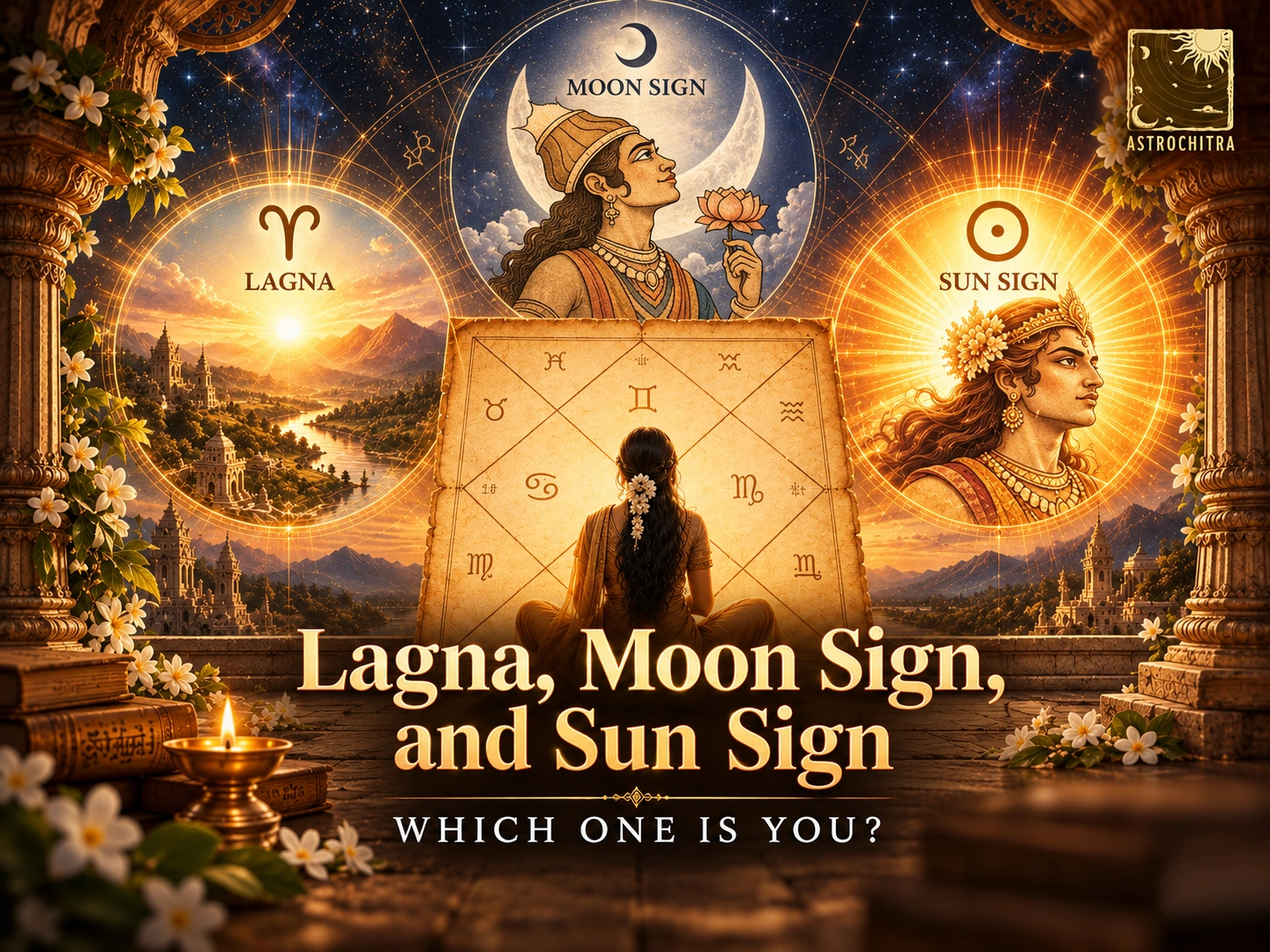
The short answer: Your Lagna describes how you approach life and how your birth chart is organised. Your Moon sign is associated with your mind, emotions and instinctive responses. Your Sun sign represents your vitality, confidence, identity and sense of purpose. They are three different reference points in the same birth chart — not three competing versions of your zodiac sign.
Key takeaways
- Lagna (Ascendant): The zodiac sign rising on the eastern horizon at the time and place of your birth. It sets the houses in your birth chart.
- Moon sign (Chandra Rashi): The sign occupied by the Moon at birth. In Vedic astrology, it is an important reference for the mind, emotional responses and many timing techniques.
- Sun sign (Surya Rashi): The sign occupied by the Sun at birth. It is associated with vitality, confidence, authority and self-expression.
- Your Lagna depends strongly on your exact birth time and location. It can change within a few hours, sometimes sooner depending on the place and the sign rising.
- You do not have to choose one sign over the others. A Vedic birth chart is interpreted by considering the Lagna, Moon, Sun, their house positions, planetary lords and aspects together.
1. Why do you have three different signs?
You may have checked your horoscope on one website and found one sign, then looked at a Vedic kundli and found another. Perhaps someone asked for your Rashi, while another person asked for your date of birth. It can sound as though astrology is giving you three different answers to the same question.
It is not.
The confusion usually comes from treating the word sign as if it has only one meaning. In a birth chart, the Lagna, Moon and Sun are three different points of reference. Each is calculated from a different astronomical position and each is used to understand a different part of life.
Think of it this way: the Lagna is the starting point from which the chart's houses are arranged; the Moon shows the sign in which the Moon was placed; and the Sun shows the sign in which the Sun was placed. All three are present in one chart.
This is also why a short newspaper horoscope cannot describe everything about a person. It usually focuses on just one sign, while a full Vedic chart considers a much wider picture.
2. What does each sign actually tell you?
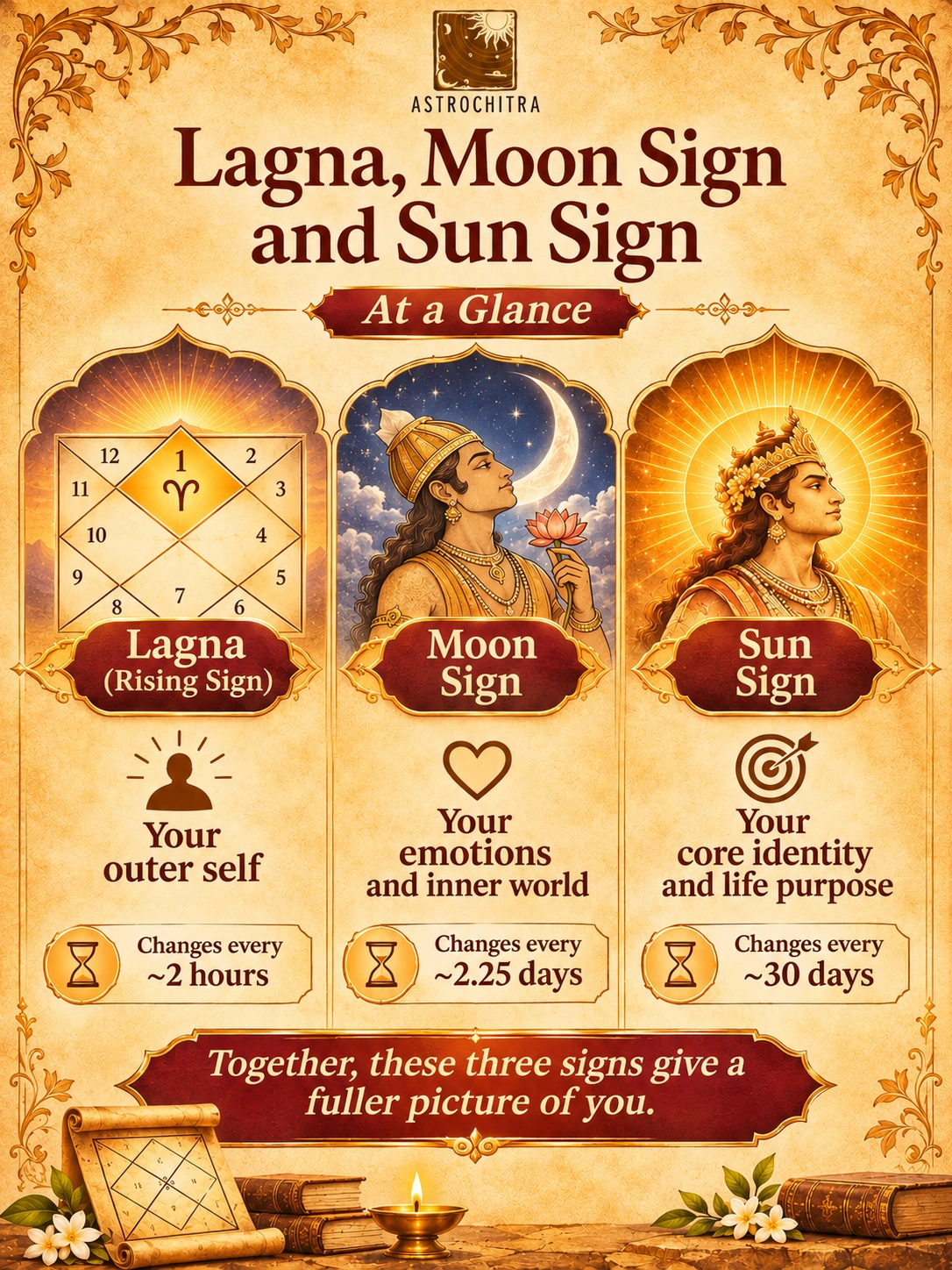
The three signs are not interchangeable. Each has a distinct role in traditional Vedic chart interpretation.
| Birth-chart factor | How it is identified | What it is used to understand | Why it matters |
|---|---|---|---|
| Lagna (Ascendant) | The sign rising on the eastern horizon at the exact time and place of birth. | Physical constitution, temperament, approach to life and the framework of the twelve houses. | It establishes the house structure of the birth chart and helps determine which planets rule each house. |
| Moon sign (Chandra Rashi) | The zodiac sign occupied by the Moon at the time of birth. | Mind, emotions, habits, comfort, instinctive reactions and subjective experience. | The Moon is central to many Vedic techniques, including reading transits from the Moon sign and understanding mental patterns. |
| Sun sign (Surya Rashi) | The zodiac sign occupied by the Sun at the time of birth. | Vitality, confidence, authority, individuality, responsibility and purpose. | The Sun is an important significator in the chart and its placement is considered alongside its house, dignity, aspects and planetary relationships. |
An easy way to remember the difference: Lagna is the lens through which the chart is organised, the Moon is associated with how you experience things internally, and the Sun is associated with vitality and the expression of your identity.
These are broad traditional associations, not fixed personality labels. A complete interpretation depends on the condition and placement of the planets, not just the sign name.
3. How are your Lagna, Moon sign and Sun sign calculated?
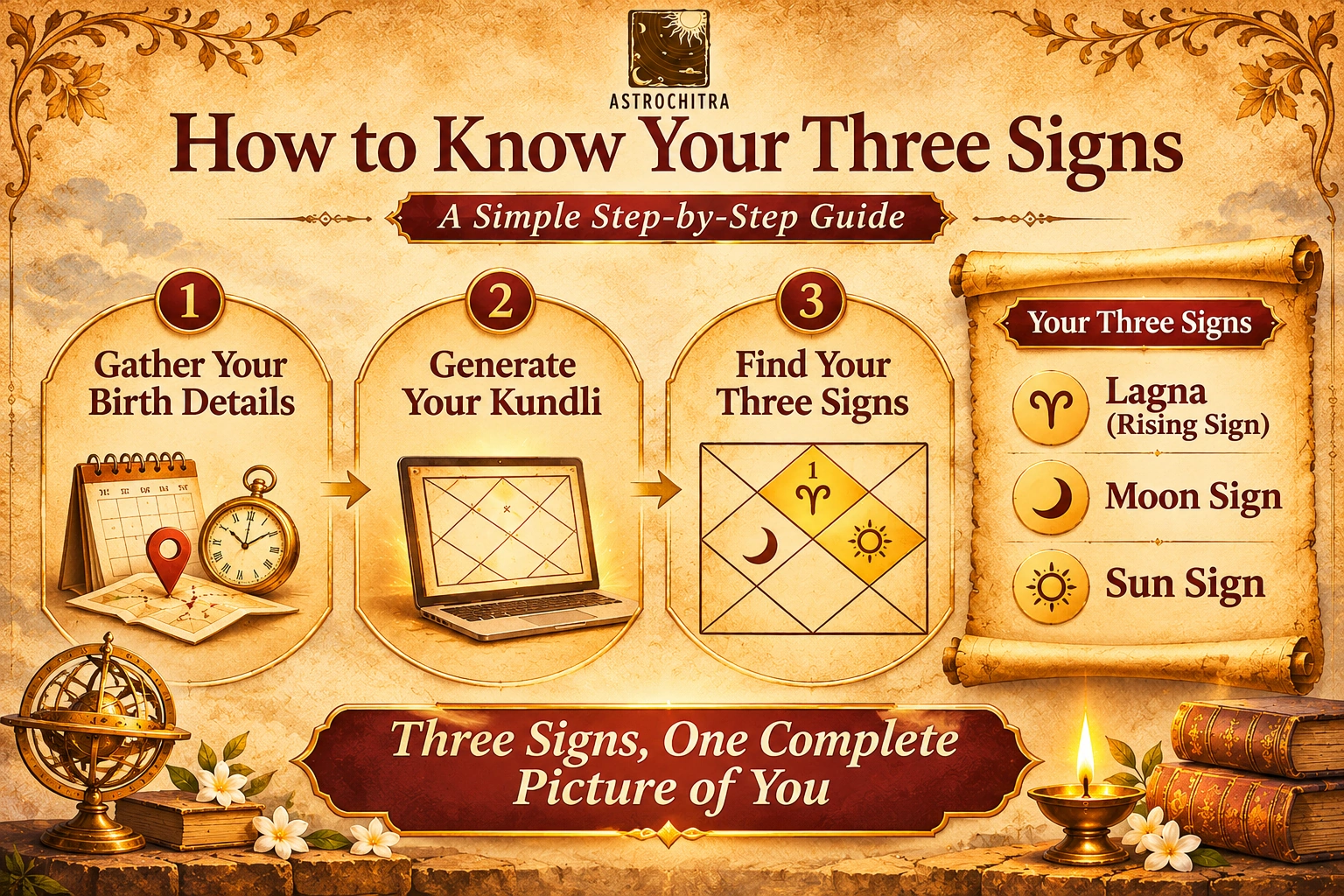
All three are calculated from the sky at the time of your birth, but they depend on different details.
Lagna is especially sensitive to birth time. As the Earth rotates, different zodiac signs rise on the eastern horizon. A sign generally remains on the horizon for around two hours, but this is only an approximation. The duration varies with latitude and the sign. A difference in birth time can therefore change the Ascendant, and that can change the house arrangement of the entire chart.
The Moon moves much faster than the Sun. It usually stays in one zodiac sign for a little over two days. This is why people born just a few days apart can have different Moon signs, even when their Sun sign is the same.
The Sun moves more slowly. In the sidereal zodiac commonly used in Vedic astrology, the Sun spends roughly a month in each sign. Your Surya Rashi is therefore usually determined by your birth date, although the exact transition date and time can vary from year to year.
To calculate the three accurately, an astrologer or a reliable Vedic chart calculator generally needs:
- Date of birth.
- Time of birth, as accurately as possible.
- Place of birth.
The place matters because the local horizon and the calculation of the Ascendant depend on geographical coordinates. The time zone and daylight-saving rules, where applicable, also need to be handled correctly.
One more detail is worth knowing: Vedic astrology generally uses a sidereal zodiac, while most popular Western Sun-sign horoscopes use a tropical zodiac. Because the two systems use different reference points, the sign shown by a Western horoscope may differ from the sign in a Vedic kundli. Always check which zodiac system a calculator is using before comparing results.
4. Can two people have the same Sun sign but different Lagnas and Moon signs?
Yes. In fact, this is very common.
Imagine two people born a week apart during the same Sun-sign period. Their Sun may be in the same sign, but the Moon may have moved into another sign between their birth dates. If they were born at different times or in different locations, their Lagnas may also be different.
Even twins can have differences in their Ascendants or house cusps when their birth times are sufficiently apart. The exact result depends on the birth times and chart calculation.
Consider a simple illustrative example:
- Person A has Taurus Lagna, a Gemini Moon and a Leo Sun.
- Person B has Leo Lagna, a Taurus Moon and a Leo Sun.
Both have the same Sun sign in this example, but their Lagnas and Moon signs are different. In a Vedic reading, the two charts would not be interpreted in the same way. Their house arrangements, planetary lordships and the placement of the Moon would need to be considered separately.
This is the reason a single Sun-sign description may feel relatable to one person and less relevant to another. It is describing one part of the chart, not the complete chart.
5. Which sign should you follow?
If you are learning Vedic astrology, start with your Lagna and understand how the twelve houses are arranged from it. Then study the Moon sign and the condition of the Moon. Finally, look at the Sun's sign and house placement.
For a beginner, this order helps avoid a common mistake: reading three separate sign descriptions and assuming that one of them must be the real you.
In practice, astrologers use different reference points for different questions. The Lagna is central to house-based chart analysis. The Moon is especially important when considering the mind and when reading many transit-based techniques. The Sun contributes to the understanding of vitality, authority, confidence and the role of the self.
The planetary lords, aspects, conjunctions, house placements and planetary strengths all add context. For example, two people may share the same Moon sign but have very different experiences because the Moon occupies a different house in each chart or receives different planetary influences.
There is no need to treat one sign as more authentic than the others. The chart is meant to be read as a connected whole.
- It does not say that your Lagna, Moon sign or Sun sign alone can describe your entire personality.
- It does not suggest that one sign is better, luckier or more powerful than another.
- It does not provide a personal prediction or replace a complete birth-chart analysis.
- It does not assume that every astrology calculator uses the same zodiac system or settings.
The important point: You do not have three identities to choose between. You have one birth chart with three important reference points. Your Lagna helps establish the structure of the chart, your Moon sign offers insight into the mind and emotional experience, and your Sun sign adds another layer connected with vitality and identity. Understanding how they work together is a better starting point than asking which one is the "real" you.
Frequently asked questions
Q: Is Rashi the same as Moon sign?
A: In common Vedic astrology usage, when someone asks for your Rashi, they usually mean your Chandra Rashi — the sign occupied by the Moon at birth. It is always worth confirming the context, because the word Rashi can also be used more broadly for a zodiac sign.
Q: Is Lagna more important than Moon sign and Sun sign?
A: The Lagna is a central reference point in Vedic birth-chart analysis because it determines the arrangement of the houses and their lords. The Moon and Sun are also important. Their relative emphasis depends on the question being examined and the overall chart.
Q: Can my Lagna change if my birth time is incorrect?
A: Yes. The Ascendant moves as the Earth rotates, so an inaccurate birth time can produce a different Lagna, particularly when the recorded time is close to a sign transition. If your birth time is uncertain, mention that when getting your chart prepared rather than treating the calculated Lagna as certain.
Q: Does my Moon sign change during my lifetime?
A: No. Your natal Moon sign is based on the Moon's position at the time of your birth and remains the same. The Moon continues moving through the zodiac every month, but those are transits, not changes to your birth-chart Moon sign.
Q: Why is my Vedic Sun sign different from my Western zodiac sign?
A: Most Western Sun-sign horoscopes use the tropical zodiac, while Vedic astrology generally uses the sidereal zodiac. Since the systems use different reference points, the Sun can fall in different signs in the two systems.
Q: What information do I need to find all three signs?
A: You generally need your date of birth, accurate birth time and place of birth. Date alone may help estimate the Sun sign, but it is not enough to calculate the Lagna reliably, and it may not be enough to establish the Moon sign near a sign transition.
Comments
Related Articles
How to Read Your Kundli
Learn how to read your kundli in Vedic astrology: the house lord first, then occupants, aspects and karaka, with a worked example.
What “Strong” and “Weak” Mean in a Chart
A strong planet is not always kind, and a weak planet is not always bad. Learn what strong and weak really mean in a Vedic birth chart, in plain language.

Vasi Yoga: Meaning, Formation, Effects & Benefits
Learn about Vasi Yoga in Vedic Astrology, its formation, effects on confidence, intelligence, wealth and prosperity, negative combinations, and remedies.