Is Manglik Dosha Real? Beyond the Fear
Is Manglik Dosha real? Learn the five Mars houses, the Lagna–Moon–Venus check, cancellation factors and kundli matching—without fear or false guarantees.

Manglik Dosha is a chart condition — not a marriage verdict.
- It is identified by Mars in the 1st, 4th, 7th, 8th or 12th house from Lagna, Moon or Venus.
- Its interpretation depends on Mars' strength, sign, aspects and the condition of the 7th house and its lord.
- Classical cancellation factors must be checked before drawing a conclusion.
- Kundli matching considers both charts. A single Manglik label cannot decide a relationship.
One word can change the way a marriage proposal is seen: Manglik.
A Mars placement is noticed. A warning follows. And sometimes, before anyone has examined the full kundli, a person is told that their marriage will be delayed, troubled or unsuccessful.
That conclusion is too quick.
So, is Manglik Dosha real? In the traditional Vedic astrology framework, yes: it is a specific condition based on Mars occupying certain houses from particular reference points. But having the condition does not automatically mean divorce, an unhappy marriage or a doomed match.
The placement is only the beginning of the reading. Mars' strength, cancellation factors, the 7th house and both partners' charts matter.
Remember this: A chart condition is not a life sentence. First understand the placement. Then examine the whole chart.
You can generate your kundli before following the checks below.
What is Manglik Dosha?
Manglik Dosha — also called Mangal Dosha — is identified when Mars occupies the 1st, 4th, 7th, 8th or 12th house from one of three reference points:
- Lagna (Ascendant)
- Moon
- Venus
Mars is associated in Vedic astrology with energy, action, heat, conflict and independence. When it occupies one of these houses, the traditional interpretation examines whether that energy may create friction or intensity in partnership matters.
The important distinction is this:
- The placement identifies a condition.
- The complete chart determines how that condition is interpreted.
It is not a curse, a character label or a guaranteed prediction of divorce.
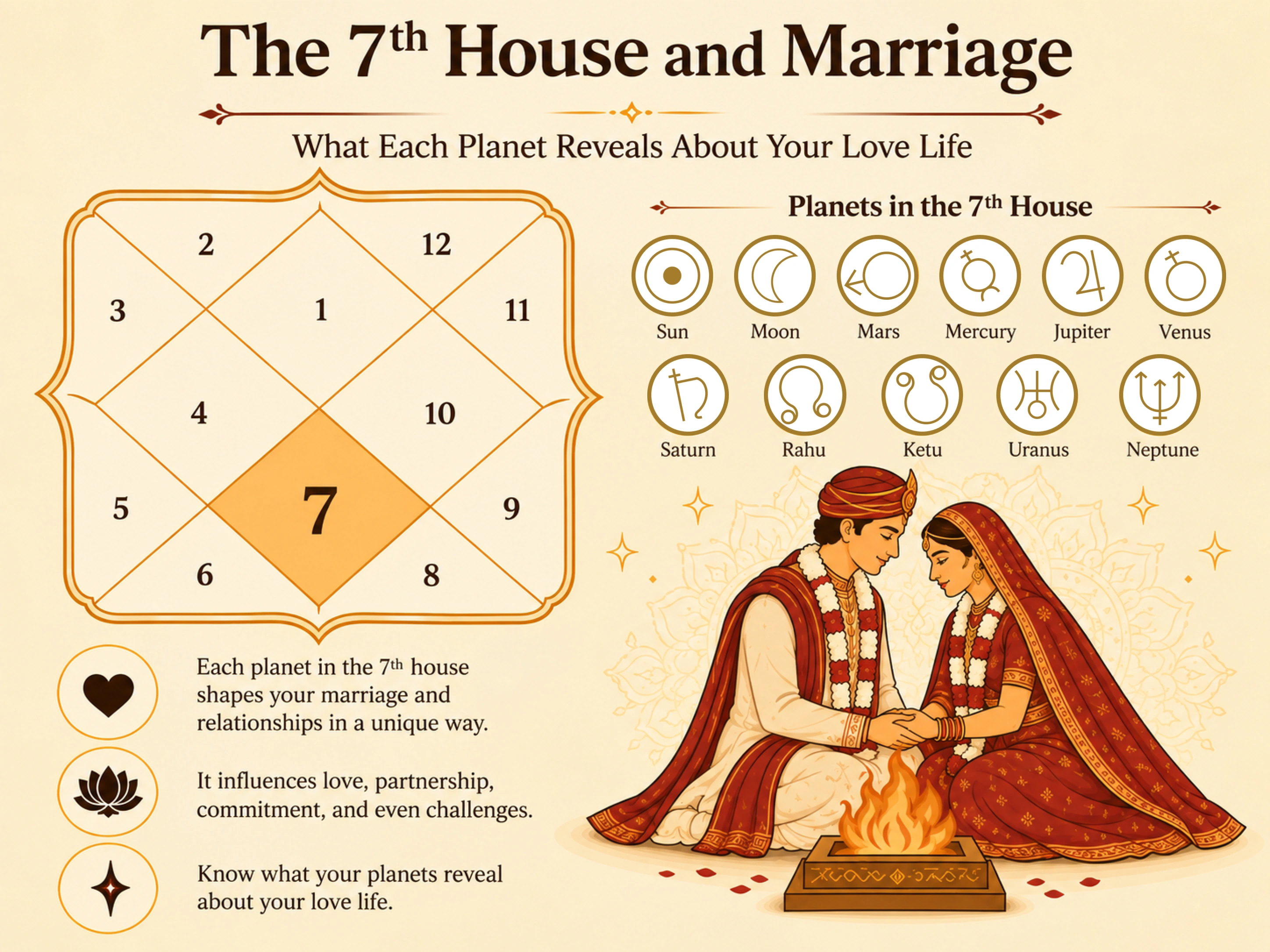
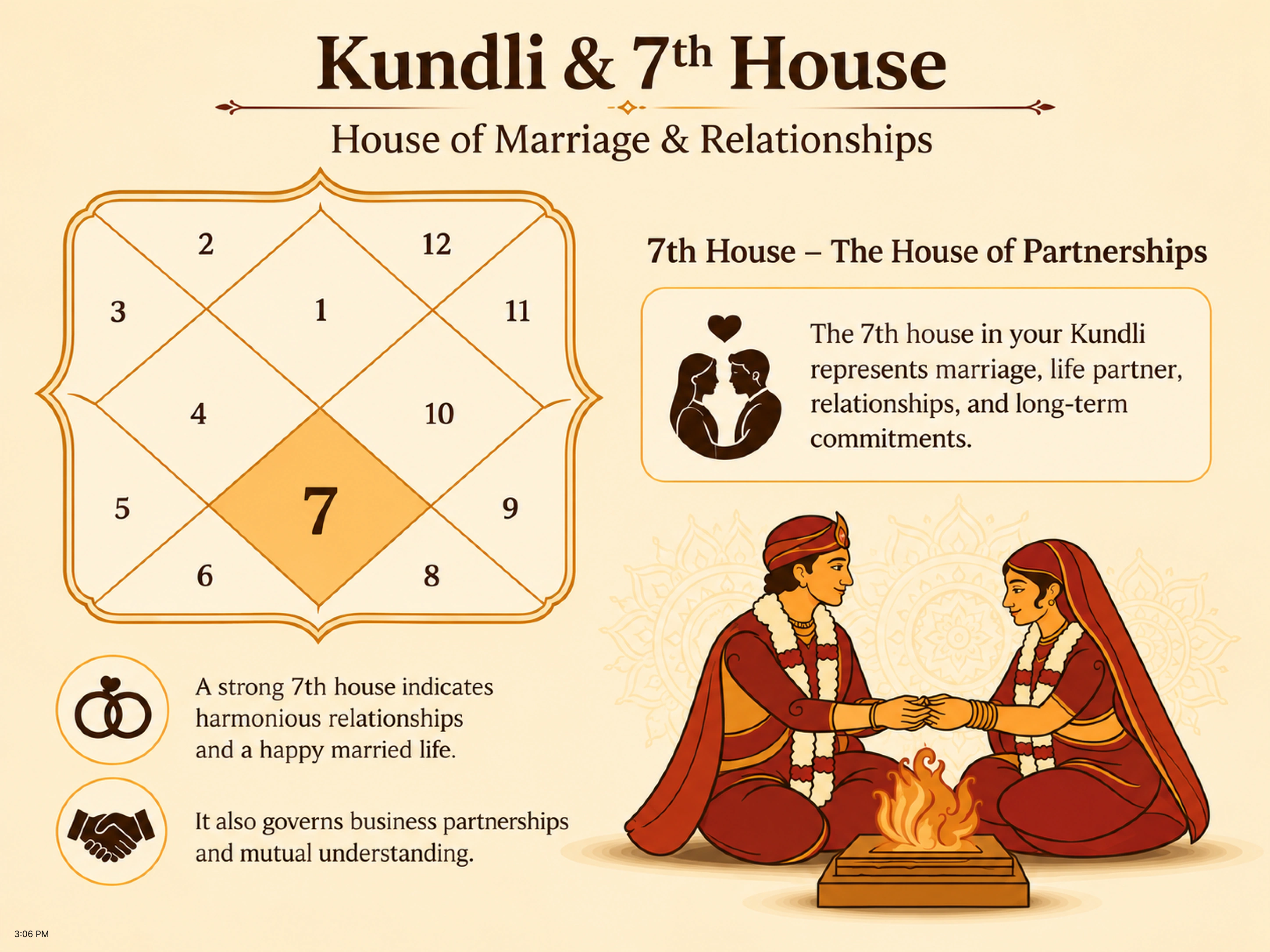
For context, read more about Mars in the chart and the seventh bhava.
Which placements create Manglik Dosha?
The same five houses are checked from all three reference points.
| Reference point | Count these houses from | What to record |
|---|---|---|
| Lagna | 1st, 4th, 7th, 8th or 12th from the Ascendant | Mars' house from Lagna |
| Moon | 1st, 4th, 7th, 8th or 12th from the Moon | Mars' house from the Moon |
| Venus | 1st, 4th, 7th, 8th or 12th from Venus | Mars' house from Venus |
The rule in one line:
Mars in 1, 4, 7, 8 or 12 from Lagna OR Moon OR Venus = a Manglik reference to examine.
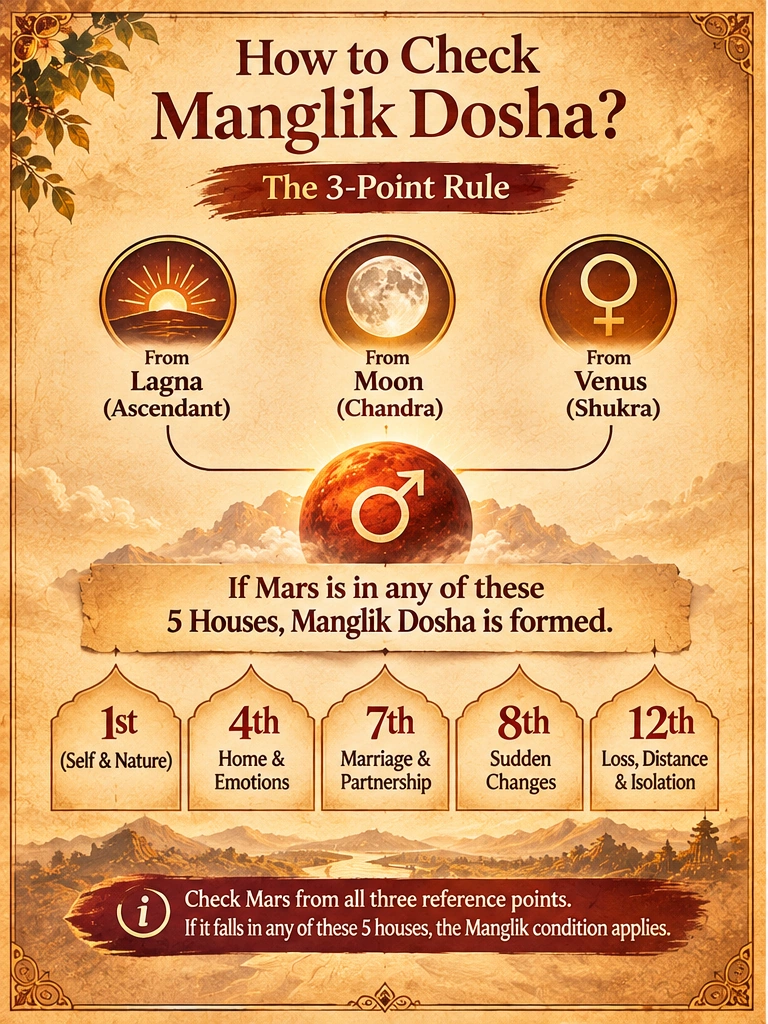
A chart may show the condition from one, two or all three reference points. That count is useful, but the count alone does not decide the strength of the dosha. Mars' dignity, aspects, benefic influence and the 7th-house picture must also be examined.
- Locate Mars in the kundli.
- Note Mars' house from Lagna, Moon and Venus separately.
- Mark whether any of those positions is 1, 4, 7, 8 or 12.
- Record Mars' sign and the aspects or conjunctions influencing it.
- Do not stop at the label. Continue to the cancellation and 7th-house checks.
What can Manglik Dosha mean for marriage?
In the traditional interpretation used in this article, Mars in these positions can bring heat, independence and intensity into partnership matters. Depending on the full chart, an astrologer may examine:
| Area being examined | What the traditional reading may consider |
|---|---|
| Marriage timing | Possible delay, particularly when Mars strongly affects the 7th- or 8th-house themes |
| Arguments and temperament | A tendency towards heated exchanges or strong reactions |
| Independence | A strong need for personal space, autonomy or an equally independent partner |
| Partner dynamics | Attraction to a strong-willed, assertive or martial partner |
These are possibilities to investigate — not outcomes that every Manglik person must experience.
What Manglik Dosha does not prove
| It does not prove… | Why that conclusion is too strong |
|---|---|
| “This person will get divorced.” | Manglik Dosha alone is not a divorce guarantee. |
| “This person cannot marry a non-Manglik.” | Matching examines both charts and the conditions modifying Mars. |
| “This person has a bad character.” | One planetary condition cannot define someone's entire personality. |
| “The person's career, money or health will suffer.” | This rule is being discussed in the context of marriage and partnership, not as a verdict on every area of life. |
| “A paid remedy is the only solution.” | Cancellation is assessed through chart conditions; it is not something to assume from a purchase. |
The mistake to avoid: Do not turn “Manglik” into a description of a person. It is a condition being examined in a chart — nothing more.
What cancels or reduces Manglik Dosha?
This is where a one-line verdict often fails.
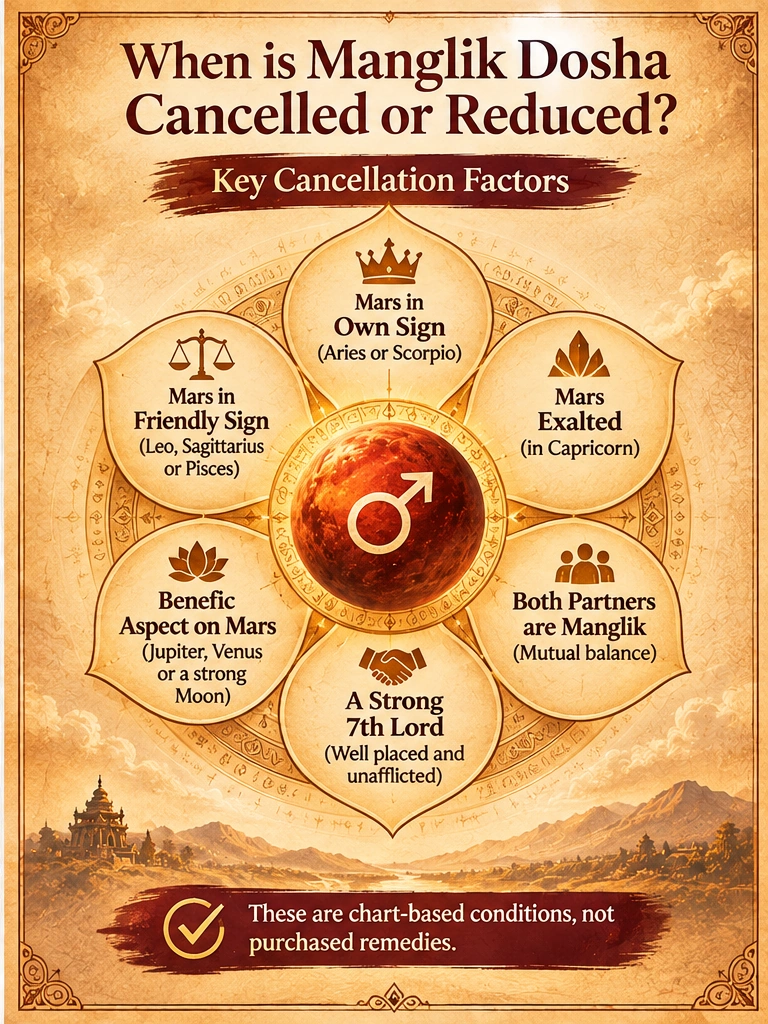
The traditional rules cited for this article include several cancellation or modifying conditions. They are examined in the chart; they are not shortcuts that replace the chart.
| Condition to check | What it means in this rule set |
|---|---|
| Mars in its own sign | Mars in Aries or Scorpio is listed as a cancellation or modifying condition. |
| Mars exalted | Mars in Capricorn is treated as an important cancellation factor in the method used here. |
| Benefic aspect on Mars | The influence of Jupiter, Venus, Mercury or Moon may moderate Mars' intensity. |
| Strong 7th lord | A well-placed and strong 7th lord can reduce the friction associated with Mars. |
| Mars in a friendly sign | Leo, Sagittarius or Pisces is treated as a moderating placement. |
| Mars conjunct a benefic | A benefic conjunction may modify how Mars expresses itself. |
| Both partners have Manglik Dosha | Some traditional matching approaches consider this a mutual cancellation factor. |
A cancellation is not a purchase
A cancellation rule is a condition in the horoscope. It is not a product, a ritual package or a promise that someone can sell you.
For example, if the method being followed treats exalted Mars in Capricorn as a cancellation factor, that condition should be visible in the chart. It should not depend on buying something after being frightened by a prediction.
Ask what is present in the chart before accepting a remedy. A genuine explanation should identify the placement, the rule being applied and the other factors that support the conclusion.
Note: Vedic astrology lineages and texts may apply or prioritise individual rules differently. The factors above follow the method and source list stated in this article; they should be read together, not as isolated automatic overrides.
Why kundli matching checks both charts
Manglik Dosha is not meant to be assessed in isolation from the prospective partner's horoscope.
Traditional kundli matching examines both charts. If both partners have Manglik Dosha, some matching approaches treat the condition as mutually balanced or cancelled. If only one chart shows it, the reading should examine the other chart's 7th house, the strength of its 7th lord and the benefic influences on Mars.
Manglik assessment is also only one part of compatibility. Ashtakoota matching may examine:
- Varna
- Vashya
- Tara
- Yoni
- Graha Maitri
- Gana
- Bhakoot
- Nadi
A single Manglik flag should not replace the wider matching process.
Explore Kundli Matching or the Matchmaking tool to assess compatibility through both charts. You can also read how two charts are matched.
What should you check before accepting a Manglik verdict?
Use this sequence instead of reacting to the word alone.
- Confirm the birth time. The chart calculation depends on accurate birth details. Check the recorded time rather than relying only on memory.
- Locate Mars. Note its house and sign.
- Check all three reference points. Count from Lagna, Moon and Venus — not just the Ascendant.
- Look for modifying conditions. Examine Mars' sign, aspects, conjunctions and the strength of the 7th lord.
- Read both charts. A marriage match should not be accepted or rejected from one person's Manglik label alone.
Before accepting a reading, ask the astrologer these three questions:
- From which reference point is the dosha being identified?
- Which cancellation or modifying conditions are present?
- How have both partners' 7th houses and charts been considered?
A clear reading should be able to answer those questions without using fear as the explanation.
The honest answer
Is Manglik Dosha real? It is a recognised chart condition within the traditional Vedic astrology framework described here. But the frightening claims often attached to the label go further than the condition itself.
Mars may indicate intensity, independence or possible friction in partnership matters. Its actual interpretation depends on its placement and strength, the cancellation factors, the 7th house and the comparison of both charts.
A chart can describe conditions. It cannot reduce a person to one label — and it cannot guarantee the future of a marriage.
If you are reviewing a proposal, start with accurate birth details and a complete chart comparison. Do not let one word make the decision for you.
Start with your birth chart, then review compatibility in context.
Frequently asked questions
Classical sources
The method in this article follows the classical references listed below. Chapter references are provided so readers can locate the source material; translations and interpretive lineages may differ.
- Phaladeepika, Mantreswara, translated by V. Subrahmanya Sastri (2nd ed., 1950). Adhyaya VI covers yogas and combinations; Adhyaya X covers the 7th house and marriage. Read the text on Archive.org.
- Brihat Parashara Hora Shastra, translated by R. Santhanam. Chapters 3, 18, 26 and 36 are cited for planetary characters, the 7th house, aspects and named yogas. Read Volume 1 on Archive.org.
For marriage-supporting combinations, see auspicious yogas for marriage or explore marriage guidance.