
When Will I Get Married? Understanding Marriage Timing in Vedic Astrology
Learn how Vedic astrology traditionally studies marriage timing through the 7th house, planetary periods (dasha), and planetary transits—without treating any date as a guarantee.

When Will I Get Married? Understanding Marriage Timing in Vedic Astrology
"When will I get married?" is one of the most common questions people ask when looking at their birth chart. You may be waiting to meet someone, wondering whether a relationship will lead to marriage, or trying to understand why marriage has not happened yet.
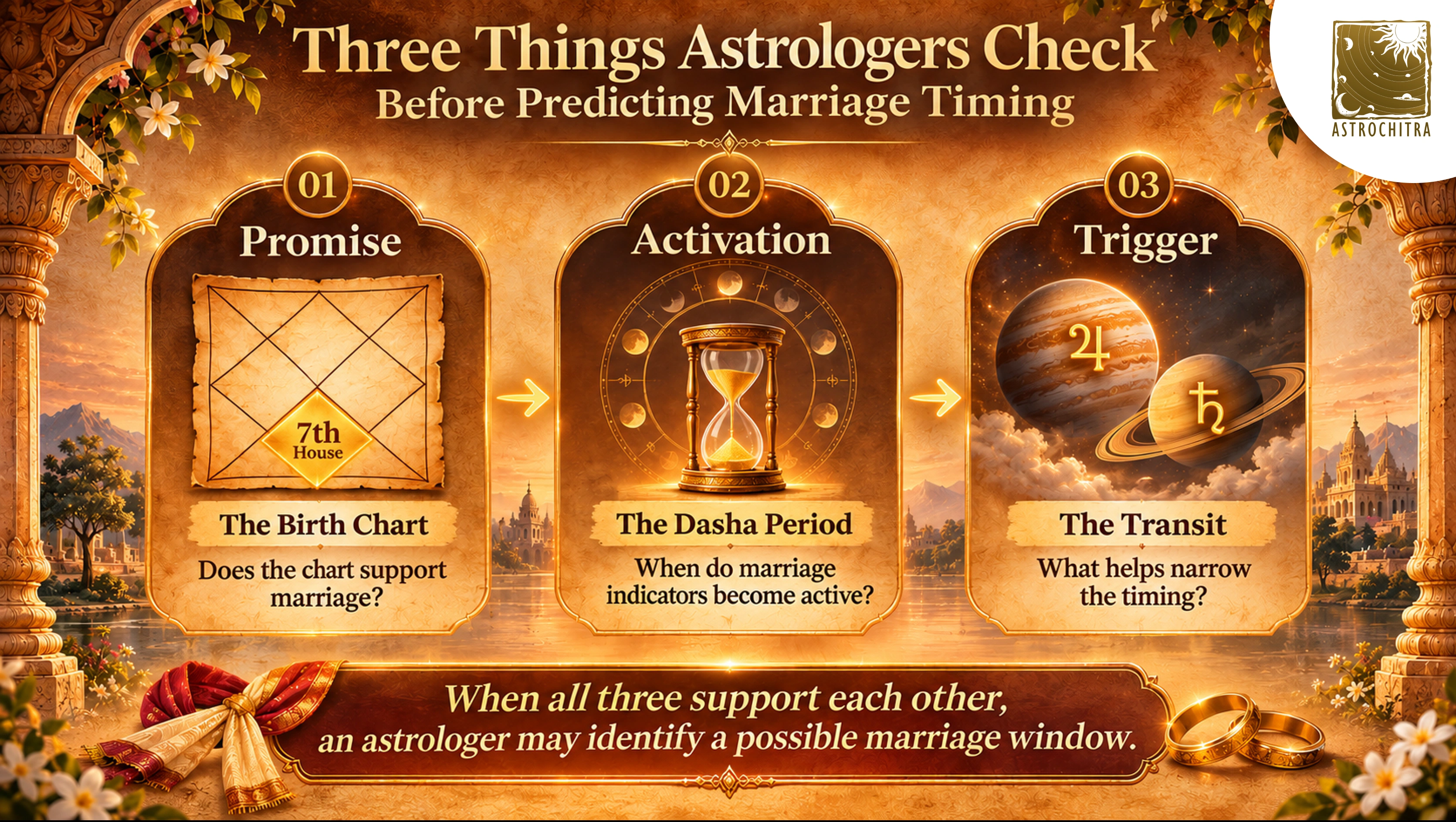
Vedic astrology has a traditional method for studying marriage timing. It does not depend on one planet, one house, or one lucky year. An astrologer looks at three things together:
- The marriage indicators in your birth chart: Do the 7th house, its ruling planet, and related planets support marriage?
- Your planetary period (dasha): Is a period connected to marriage active in your life?
- Planetary transits (gochar): Are Jupiter or Saturn moving through signs that support the timing indicated by the dasha?
When these factors support one another, an astrologer may identify a period in which marriage is more likely to become an important life event. This is a possible timing window, not a guaranteed wedding date.
Key takeaways
- The 7th house is the main house astrologers examine for marriage and long-term partnership.
- The planet that rules the 7th house, called the 7th lord, helps show how the marriage theme is placed in your chart.
- Venus and Jupiter are also examined as marriage-related significators in classical Vedic astrology. Their role should be understood in the context of the whole chart.
- A dasha is a planetary period. The main period and its shorter sub-period help an astrologer study when a chart's marriage indicators may become active.
- Jupiter and Saturn transits are timing clues. A transit alone cannot promise marriage.
- Astrology can suggest a period for closer attention, but it cannot guarantee an exact date or replace your choices and circumstances.
Why can't one astrologer simply tell you the year?
You may have heard different predictions: one person says marriage will happen this year, another says you should wait two more years, and someone else points to a particular planetary transit.
These differences can happen because a single factor is not the complete method. For example, a Jupiter transit may look supportive, but the planetary period running at that time may not be strongly connected to marriage. Another person may have a similar 7th-house arrangement but a completely different dasha sequence.
Think of the three checks as parts of one process:
- The birth chart shows the possibility being examined.
- The dasha shows when that part of life may become active.
- The transit helps narrow down the timing.
Looking at only one of these can lead to an incomplete prediction. That is why a responsible reading should explain which chart factors support a proposed period instead of giving a year without an explanation.
1. Start with the 7th house: the house of marriage
In a Vedic birth chart, the 7th house is the main area examined for marriage, committed relationships, and partnerships. It is not the only house that matters, but it is the starting point.
An astrologer usually checks four things.
The 7th house and its ruling planet
Every house in a birth chart is associated with a zodiac sign. Each sign is ruled by a planet. The planet that rules the sign in your 7th house is called your 7th lord.
For example, if Gemini is in your 7th house, Mercury is the 7th lord because Mercury rules Gemini. The astrologer then checks where Mercury is placed in your chart and how strong or supported it is.
The 7th lord is important because it connects the marriage house to another area of life. Its placement may describe the circumstances through which relationships develop. For example, a connection with the 11th house may bring attention to friends, networks, or social circles. A connection with the 6th house may point to relationships developing alongside work, responsibilities, or practical challenges. These are traditional interpretations, not fixed outcomes.
Planets placed in or influencing the 7th house
Planets occupying the 7th house, or influencing it through their aspects, add more information to the reading. They do not replace the 7th lord.
In traditional interpretation, Saturn may bring seriousness, responsibility, or a slower approach to commitment. Jupiter may be read as supportive or growth-oriented, while Mars may bring intensity or impatience. The result depends on the planet's overall condition and the rest of the chart. No single placement should be treated as a final verdict about marriage.
Venus and Jupiter
Venus is widely used as a significator of attraction, relationships, affection, and harmony in classical Vedic astrology. Jupiter is also examined in marriage readings; some classical traditions describe Jupiter as the significator of the husband. That traditional convention should not be used as a universal rule about a person's gender or relationship.
An astrologer studies Venus and Jupiter alongside the 7th house and its lord. A strong Venus or Jupiter does not, by itself, tell you when marriage will happen.
The overall strength of these indicators
Astrologers also consider whether the 7th lord, Venus, and Jupiter are well-supported or affected by other planetary influences. They may examine dignity, combustion, retrogression, and aspects. These are technical terms describing a planet's condition in the chart.
You do not need to calculate all of this yourself. The important point is that the astrologer should explain the condition of the 7th house and its lord before making a timing prediction.
The 2nd and 11th houses can provide supporting information. The 2nd house is associated with family and the household formed after marriage; the 11th is associated with fulfilment of wishes, gains, and social networks. They add context, but they do not replace the 7th house.
To explore this part of your chart, you can generate your kundli, read how the 7th house is understood in marriage, or learn more about Venus in a birth chart.
2. Understand your dasha: when can the marriage indicators become active?
Even when a birth chart has marriage-related indicators, astrologers do not assume that marriage will happen immediately. They next examine the dasha, or planetary period, running at that time.
In the Vimshottari dasha system, two levels are especially useful to understand:
- Mahadasha: the main planetary period. It gives the broader theme for a longer stretch of life.
- Antardasha: a shorter sub-period within the main period. It helps narrow down when a particular event may become more relevant.
For marriage timing, an astrologer looks for a connection between the running period and the 7th house, its lord, or marriage-related significators.
Periods that may be considered include:
- The mahadasha or antardasha of the 7th lord.
- The period of a planet placed in the 7th house.
- The period of a planet that aspects or is otherwise connected to the 7th house or its lord.
- A Venus or Jupiter period, especially when that planet is connected to the marriage indicators in the chart.
- In some charts, periods connected to the 2nd or 11th house may provide additional support.
The important word is connected. A Venus period is not automatically a marriage period for everyone. The astrologer needs to check what Venus rules, where it is placed, and how it relates to the 7th house in that particular chart.
Mahadasha and antardasha in simple terms
| Period | What it means | How it helps with timing |
|---|---|---|
| Mahadasha | The main planetary period. | Shows the broader life theme that may be active for a longer time. |
| Antardasha | A shorter sub-period within the mahadasha. | Helps narrow the period in which marriage-related themes may become active. |
| Transit (gochar) | The current movement of a planet through the zodiac. | Acts as an additional timing clue when it supports the birth chart and dasha. |
For example, a person may be running a mahadasha that supports relationships, but the antardasha may not strongly connect with the 7th house. An astrologer may therefore look for a more supportive sub-period before identifying a likely marriage window.
This does not mean that a difficult sub-period permanently blocks marriage. It means the timing needs to be read carefully rather than judged from the main period alone.
To understand the planetary periods in your own chart, read Mahadasha and Antardasha explained.
3. Check planetary transits: what may narrow the timing?
A transit, also called gochar, is the current movement of a planet through a zodiac sign. After examining the birth chart and the running dasha, an astrologer studies transits for additional timing clues.
Two planets commonly considered in this part of a traditional timing reading are Jupiter and Saturn. Jupiter generally stays in a zodiac sign for about a year, while Saturn generally stays in a sign for around two and a half years. Their movements are therefore used to study broader periods rather than exact wedding dates.
Why the Moon sign is considered
The Moon's zodiac sign at birth is called your Moon sign or Janma Rashi. In traditional Vedic astrology, many general transit interpretations are counted from this sign.
This is one reason the same Jupiter or Saturn transit may be interpreted differently for two people. Their Moon signs, birth charts, and running dashas may be different.
Another check: the 7th lord's sign
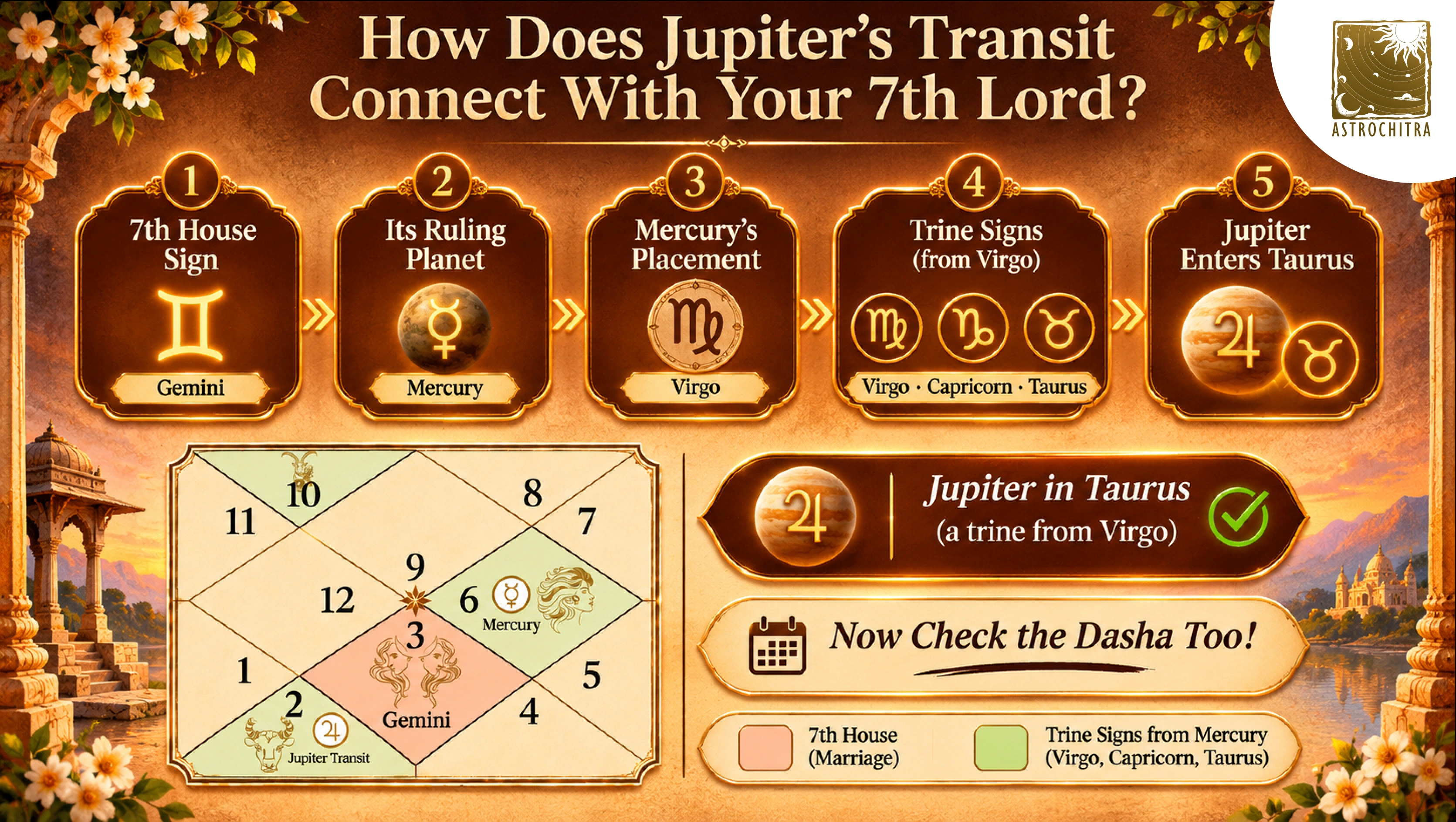
Some classical timing rules also examine the zodiac sign occupied by the 7th lord. One rule discussed in Phaladeepika looks at Jupiter moving through the 7th lord's sign or signs that form a trine from it. A trine means the sign itself and the signs in the 5th and 9th positions from it.
This gives an astrologer another place to look beyond the 7th house itself. In a detailed reading, the astrologer may also consider the 7th lord's Navamsa placement. These are additional checks, not shortcuts that override the birth chart or dasha.
A simple example
Imagine Gemini is in the 7th house. Mercury rules Gemini, so Mercury is the 7th lord. Now suppose Mercury is placed in Virgo in the birth chart.
The signs forming a trine from Virgo are Virgo, Capricorn, and Taurus. Under the specific Jupiter transit rule described above, Jupiter moving through one of these signs may be treated as a supporting timing clue.
| Step | What the astrologer checks | Example |
|---|---|---|
| 1. Find the 7th-house sign | Which sign is placed in the 7th house? | Gemini |
| 2. Find the 7th lord | Which planet rules that sign? | Mercury |
| 3. Find where the 7th lord sits | Which sign contains Mercury in the birth chart? | Virgo |
| 4. Find the trine signs | Which signs are 1st, 5th, and 9th from Virgo? | Virgo, Capricorn, and Taurus |
| 5. Check Jupiter's transit | Is Jupiter moving through one of those signs? | Jupiter in Taurus would meet this one transit condition. |
| 6. Check the dasha | Is a marriage-related planetary period also active? | The astrologer checks whether Mercury or another connected planet is active in the dasha. |
Notice that Jupiter in Taurus is only one part of this example. It is not enough to predict a wedding by itself. The astrologer still needs to consider the full birth chart, the running dasha, and other relevant factors.
You can check the current planetary transits, but remember that a transit describes where a planet is moving. It does not, on its own, tell you what must happen in your life.
Why might a predicted marriage period pass without a wedding?
A timing window is not a promise that an event must happen. A period may look supportive in one part of the reading but less supportive when the other factors are considered. Real-life decisions, relationships, family circumstances, and personal readiness also matter.
Here are some reasons an astrologer may review a prediction again:
| What needs reviewing | Why it matters | What you should not assume |
|---|---|---|
| The dasha and the birth-chart indicators | A supportive 7th house may not have a strongly connected planetary period running at that time. | It does not automatically mean marriage is denied. |
| The antardasha | The shorter sub-period may bring complications, delays, or a period of adjustment. | It does not mean the entire mahadasha is useless. |
| The transit being checked | Looking only at the 7th house may miss a rule that also considers the 7th lord's sign. | It does not mean there are no other timing indicators. |
| Additional chart calculations | Some astrologers use tools such as Ashtakavarga to judge the strength of a transit. | One calculation should not be treated as the whole reading. |
| Birth-time accuracy | An incorrect birth time can change important chart details and the timing calculated from them. | It does not make every part of the chart meaningless, but the reading may need to be checked. |
| Real-life circumstances | A chart reading does not make decisions, create a relationship, or remove practical responsibilities. | It does not mean you should stop taking action in your own life. |
The useful question is not simply, "Why did the prediction fail?" Ask which part of the reading was considered supportive, what other factors were present, and whether the birth details were accurate.
What can you do with this information?
You do not need to become an astrologer to have a more useful conversation about marriage timing. Start with accurate birth details and ask for an explanation of the three checks.
Before getting a marriage-timing reading
- Confirm your birth time. A birth certificate or hospital record is more reliable than an uncertain memory, where available.
- Ask for your dasha dates. A useful reading should identify the mahadasha and antardasha being considered, not just mention a year.
- Ask why the 7th house is considered supportive or challenging. The astrologer should explain the 7th lord and the condition of the relevant planets.
- Ask which transit is being used. Find out whether the reading is based on your Moon sign, the 7th lord's sign, or another chart factor.
- Keep your own choices in the picture. Stay open to meeting people, communicating clearly, and considering introductions. A chart reading should not make you passive or fearful.
Questions you can ask your astrologer
- Which factors in my birth chart are being used to assess marriage?
- Which mahadasha and antardasha are relevant, and why?
- Which Jupiter or Saturn transit is being considered as a timing clue?
- Is the period a broad possibility or a stronger indication? What could change the interpretation?
- Is my recorded birth time accurate enough for this level of timing analysis?
Be cautious of anyone who uses fear, promises a guaranteed wedding date, or pressures you to buy an expensive remedy. In the classical approach discussed here, remedies are not a purchase that can force an event to happen or move a planetary period. Personal conduct, patience, and practical decisions still matter.
The most important thing to remember
Vedic astrology traditionally studies marriage timing through a combination of the 7th house, its ruling planet, relevant planetary periods, and transits. Each layer answers a different question: what the birth chart indicates, when those indicators may become active, and which broader planetary movements may support the timing.
This approach can help explain why an astrologer is considering a particular period. It cannot promise that you will marry on a specific date, and it should never be used to create fear or make you feel that your future is fixed.
Rather than asking only, "Which year will I get married?", ask, "What in my chart supports this period, and how are the dasha and transits connected to it?" That gives you a clearer explanation and a more meaningful reading.
Frequently asked questions
Can marriage happen outside the 7th lord's dasha?
Yes. In traditional Vedic astrology, a period connected to a planet placed in the 7th house, a planet influencing the 7th house or its lord, or a marriage-related significator such as Venus may also be considered. The 7th lord's period is an important route, but it is not the only one.
Does Saturn in the 7th house always delay marriage?
No. Saturn in the 7th house should not be treated as an automatic denial or a fixed delay. Traditional interpretations may associate Saturn with patience, responsibility, or a more cautious approach to commitment. Its meaning depends on the full chart and the running planetary period.
Can I know my marriage timing without knowing my birth time?
A Moon-sign-based transit reading may offer broad information, but a detailed assessment of the 7th house, its lord, and dasha timing depends on accurate birth details. Without a reliable birth time, important parts of the analysis may be uncertain.
Do remedies change marriage timing?
Remedies should not be treated as a way to purchase or guarantee marriage. The classical approach discussed in this article includes ideas such as discipline, charity, and personal conduct. No remedy should replace practical decisions or be presented as a guaranteed way to change a date.
Does a strong 7th house mean I will get married soon?
Not necessarily. The 7th house is one part of the reading. An astrologer also examines the 7th lord, Venus and Jupiter, the running dasha, and relevant transits. A strong marriage indicator does not by itself identify the timing.
Classical sources
The traditional method discussed in this article draws on the following classical works. Chapter references are provided for readers who want to explore the source material; they are not a substitute for a complete chart reading.
- Phaladeepika, by Mantreswara, translated by V. Subrahmanya Sastri (2nd edition, 1950). Chapter X discusses the 7th house and marriage; Chapter XXVI discusses transits. Read the text on Archive.org.
- Brihat Parashara Hora Shastra, translated by R. Santhanam. Chapters 18, 24, and 48 are relevant to the discussion of the 7th house, house lords, and planetary periods. Read Volume 1 on Archive.org.
For readers who want to explore related topics, see marriage-supporting yogas, kundli matching, and how Vedic astrology compares two charts.
Comments
Related Articles

When Will My Money Situation Improve?
How Vedic astrology reads money timing through the 2nd and 11th houses, Jupiter, dasha and transits, and why earning more is not the same as keeping more.
Auspicious Yogas for Marriage in Vedic Astrology
When Will a Difficult Period End?
Find when a tough phase may ease in your Kundli. Learn how sub-period end dates, Upachaya houses and slow transits shape a difficult dasha, without fear.