
Which Dasha Am I In? Find Your Mahadasha and Antardasha
Learn how to find your current Vimshottari Dasha from your birth Moon Nakshatra. Understand the Mahadasha sequence, calculate the balance at birth, and identify your Antardasha.
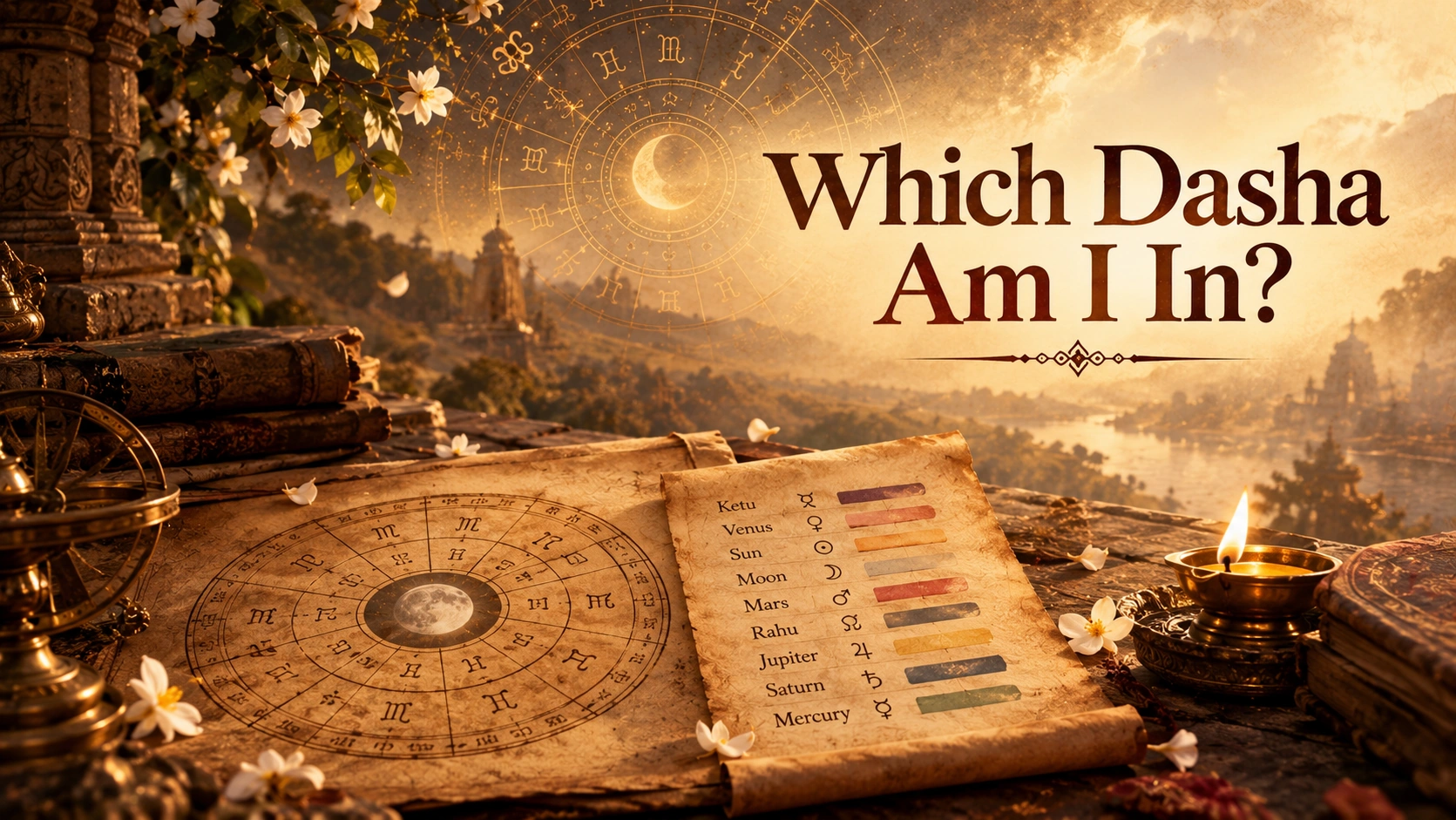
In the Vimshottari Dasha system, your first Mahadasha is decided by the Nakshatra occupied by the Moon at birth. To find the Dasha running now, identify that Nakshatra, calculate the balance of the first Mahadasha, and follow the planetary sequence up to the present date.
- Find the Moon's birth Nakshatra.
- Identify the Nakshatra lord.
- Calculate the balance of the first Mahadasha at birth.
- Use the Dasha sequence to find the current Mahadasha and Antardasha.
Which Dasha Am I In?
A Kundli shows the positions of the planets at the time of birth. Vedic astrology also uses those positions to calculate Dasha periods—the periods ruled by different planets during a person's life.
If you have searched your Kundli for your current Dasha, you may have come across terms such as Vimshottari, Mahadasha, Antardasha and Nakshatra. These terms are connected, but each has a specific meaning.
This guide explains the terms first, then takes you through the calculation step by step. You will learn how to find your current Mahadasha and the Antardasha running within it.
Generate your Kundli if you do not have your birth chart.
The terms you need to know
You do not need to know every term in Vedic astrology to follow this method. Start with these:
| Term | Meaning |
|---|---|
| Dasha | A period of time ruled by a particular planet. |
| Vimshottari Dasha | A Dasha system of 120 years, divided among nine planetary lords. |
| Graha | A celestial body used in Jyotisha; the nine Dasha lords include the Sun, Moon, planets, Rahu and Ketu. |
| Nakshatra | One of 27 divisions of the zodiac, each measuring 13°20′. |
| Janma Nakshatra | The Nakshatra occupied by the Moon at the time of birth. It sets the starting point of Vimshottari Dasha. |
| Dasha lord | The Graha that rules a particular Dasha period. |
| Mahadasha | The major Dasha period. It is the main period being considered. |
| Antardasha | A smaller period that runs within a Mahadasha. It is also called Bhukti. |
| Pratyantardasha | A smaller period within an Antardasha. |
| Pada | One-fourth of a Nakshatra. Each Pada measures 3°20′. |
What is Vimshottari Dasha?
Vimshottari Dasha is a system used in Vedic astrology to study the timing of planetary periods. It assigns a fixed number of years to each of nine Grahas, making a complete cycle of 120 years.
The nine periods follow a fixed order. The first period is not the same for everyone: it is decided by the lord of the person's Janma Nakshatra.
The nine Dasha lords and their periods
| Order | Dasha lord | Duration |
|---|---|---|
| 1 | Ketu | 7 years |
| 2 | Venus (Shukra) | 20 years |
| 3 | Sun (Surya) | 6 years |
| 4 | Moon (Chandra) | 10 years |
| 5 | Mars (Mangal) | 7 years |
| 6 | Rahu | 18 years |
| 7 | Jupiter (Guru) | 16 years |
| 8 | Saturn (Shani) | 19 years |
| 9 | Mercury (Budha) | 17 years |
| Total | 120 years |
After Mercury, the sequence returns to Ketu.
Keep the two levels clear: Mahadasha is the major period. Antardasha is the sub-period within it. For example, “Rahu Mahadasha – Venus Antardasha” means Rahu is the major-period lord and Venus is the sub-period lord.
How to find your current Dasha
There are four main steps. You need your birth details or a Kundli that shows the Moon's Nakshatra and exact position.
Step 1: Find the Moon's Nakshatra in your Kundli
The Janma Nakshatra is the Nakshatra occupied by the Moon at the time of birth. It determines which Graha starts your Vimshottari Dasha sequence.
A Nakshatra is one of 27 divisions of the zodiac. Each division covers 13°20′. The Moon moves through these divisions, and the one it occupies at birth becomes the Janma Nakshatra.
To find it in your Kundli:
- Open the planetary-position table or Graha details.
- Find the Moon, often written as Moon or Chandra.
- Look for the Nakshatra shown against the Moon.
- Note the Moon's exact degree and minute as well. You will need this for the balance calculation.
Rashi and Nakshatra are not the same. Rashi means zodiac sign; Nakshatra is a smaller division within the zodiac. Your Moon has both a Rashi and a Nakshatra position.
Generate your Kundli if you need your planetary positions.
In Vimshottari Dasha, the Moon's Nakshatra at birth decides the first Dasha lord. The Moon's exact position within that Nakshatra decides how much of the first Mahadasha remains at birth.
Step 2: Find the lord of your Janma Nakshatra
The Nakshatra lord is the Graha assigned to that Nakshatra. Its Dasha is the first Mahadasha in your Vimshottari sequence.
Each of the nine Dasha lords rules three Nakshatras. Use the table below to find the lord of your Janma Nakshatra.
| Dasha lord | Nakshatras ruled |
|---|---|
| Ketu | Ashwini, Magha, Mula |
| Venus (Shukra) | Bharani, Purva Phalguni, Purva Ashadha |
| Sun (Surya) | Krittika, Uttara Phalguni, Uttara Ashadha |
| Moon (Chandra) | Rohini, Hasta, Shravana |
| Mars (Mangal) | Mrigashira, Chitra, Dhanishtha |
| Rahu | Ardra, Swati, Shatabhisha |
| Jupiter (Guru) | Punarvasu, Vishakha, Purva Bhadrapada |
| Saturn (Shani) | Pushya, Anuradha, Uttara Bhadrapada |
| Mercury (Budha) | Ashlesha, Jyeshtha, Revati |
Example: If your Janma Nakshatra is Rohini, the Moon is its lord. Your first Mahadasha is therefore Moon Mahadasha. If your Janma Nakshatra is Ardra, your first Mahadasha is Rahu Mahadasha.
This gives you the first Dasha lord. The next step is to calculate how much of that Mahadasha remained when you were born.
Step 3: Calculate the balance of the first Mahadasha
Dasha balance at birth means the uncompleted part of the first Mahadasha on your birth date. You are not necessarily born on the first day of that Mahadasha.
The Moon may already have travelled partway through its Janma Nakshatra before your birth. The proportion of the Nakshatra still remaining is used to calculate the balance of the first Mahadasha.
Balance of Mahadasha at birth
Mahadasha duration × (Nakshatra portion remaining ÷ 13°20′)
Nakshatra portion remaining = 13°20′ − the Moon's progress within that Nakshatra.
Example: Finding the balance
Suppose the Moon is 8° into a Nakshatra ruled by the Sun.
- The full Nakshatra measures 13°20′.
- The Moon has travelled 8° within it.
- The remaining portion is 5°20′.
- This means 40% of the Nakshatra remains.
- Sun Mahadasha lasts 6 years.
So:
6 × 40% = 2.4 years
Approximately 2.4 years of Sun Mahadasha remain at birth.
| Part of the calculation | Value |
|---|---|
| Full Nakshatra | 13°20′ |
| Moon's progress | 8° |
| Nakshatra remaining | 5°20′ |
| Portion remaining | 40% |
| Sun Mahadasha duration | 6 years |
| Balance at birth | 2.4 years |
Do not use the Pada number as the full calculation. A Nakshatra has four Padas, each measuring 3°20′. The Pada tells you which quarter the Moon occupies, but an accurate Dasha balance requires the Moon's exact position within the Nakshatra.
This example shows the method. For an accurate date, use the exact birth time, place, Moon longitude and the calculation convention used by your Kundli software or astrologer.
Step 4: Build the Mahadasha timeline
The Mahadasha timeline shows when each major planetary period begins and ends. Start with the balance remaining at birth, then follow the fixed Vimshottari order.
To build the timeline:
- Write down the balance of the first Mahadasha at birth.
- After that balance ends, add the full duration of the next Dasha lord.
- Continue through the Vimshottari sequence.
- Compare the start and end dates with the date for which you want to check the Dasha.
- The Mahadasha covering that date is the current Mahadasha.
Example: A person born in Sun Mahadasha
Assume the person has 2.4 years of Sun Mahadasha remaining at birth. The next periods follow the sequence: Moon, Mars, Rahu, Jupiter and so on.
| Approximate age | Mahadasha | Why it appears here |
|---|---|---|
| Birth to 2.4 years | Sun | Balance remaining at birth |
| 2.4 to 12.4 years | Moon | Full 10-year period |
| 12.4 to 19.4 years | Mars | Full 7-year period |
| 19.4 to 37.4 years | Rahu | Full 18-year period |
| 37.4 to 53.4 years | Jupiter | Full 16-year period |
This is an example timeline, not a reading for a particular person. In an actual Kundli, the calculated dates are used rather than rounded ages.
How to find your Antardasha
Antardasha is the sub-period that runs within a Mahadasha. It adds another Dasha lord to the period being studied.
For example, in Saturn Mahadasha – Mercury Antardasha, Saturn is the Mahadasha lord and Mercury is the Antardasha lord.
The Antardasha sequence begins with the Mahadasha lord and then follows the same nine-planet order. So the Antardasha order within Sun Mahadasha is:
Sun → Moon → Mars → Rahu → Jupiter → Saturn → Mercury → Ketu → Venus
Antardasha duration formula
Length of an Antardasha
Mahadasha years × Antardasha lord's years ÷ 120
The answer is the Antardasha duration in years.
Example: Sun Mahadasha – Moon Antardasha
- Sun Mahadasha = 6 years.
- Moon's Vimshottari period = 10 years.
6 × 10 ÷ 120 = 0.5 years, or approximately 6 months.
Therefore, Sun–Moon Antardasha lasts about six months.
The same formula is used for every Mahadasha and Antardasha combination. The nine Antardasha durations within a Mahadasha add up to the full duration of that Mahadasha.
In Vimshottari, the first Antardasha is ruled by the same Graha as the Mahadasha. The remaining eight follow in the regular order. For example, Saturn Mahadasha begins with Saturn Antardasha, followed by Mercury, Ketu, Venus, Sun, Moon, Mars, Rahu and Jupiter.
How is a Dasha interpreted?
The Dasha lord gives the period its main astrological context. Its results are judged from its position and role in the complete Kundli—not from the planet's name alone.
When an astrologer studies a Mahadasha and Antardasha, these are some of the chart factors considered:
| Chart factor | What it means |
|---|---|
| Bhava | A house in the Kundli. Each house represents an area of life. |
| Rashi | The zodiac sign occupied by a Graha. |
| House lordship | The house or houses ruled by a Graha in that Kundli. |
| Placement | The house and sign in which the Graha is located. |
| Yuti | A conjunction: two or more Grahas placed together. |
| Drishti | A planetary aspect: the influence one Graha casts on another house or Graha. |
| Gochar | The current movement of planets, also called transit. |
The astrologer considers the Mahadasha lord, the Antardasha lord, their placements and connections, and the relevant transits. The same Dasha lord can be connected with different areas of life in different Kundlis.
This is why a planet's period should not be labelled automatically as good or bad. A complete interpretation needs the full birth chart.
Why can Dasha dates differ between calculators?
Two calculators may show slightly different dates because they may not use the same birth details or calculation settings.
| Factor | How it can affect the result |
|---|---|
| Birth time | A different time changes the Moon's calculated position. This can change the balance at birth, especially when the Moon is near the end of a Nakshatra. |
| Time zone and place | The correct local time and location are needed to calculate the planetary positions for the birth moment. |
| Ayanamsha | The value used to relate the sidereal zodiac to the equinox-based zodiac. Different settings can slightly change the Moon's sidereal longitude. |
| Year-length convention | Software may use different conventions when converting Dasha years into calendar dates. |
| Rounding | Some tools round planetary positions or Dasha dates for display. |
For a useful comparison, enter the same date, exact birth time and birth place, and select the same Ayanamsha and Dasha settings wherever possible.
Common mistakes when checking your Dasha
- Using the Sun sign: Vimshottari begins from the Moon's Janma Nakshatra, not the Sun sign.
- Starting the first Mahadasha from the birth date: The first period may already be partly completed at birth. Calculate its balance first.
- Using only the Pada: The Pada is a quarter of a Nakshatra. The exact Moon position within the Nakshatra is needed for the balance calculation.
- Mixing up Mahadasha and Antardasha: Mahadasha is the major period; Antardasha is the sub-period within it.
- Judging a period by its lord alone: The Dasha lord must be studied in the context of the full Kundli.
- Treating every calculator date as exact: Check the birth details and calculation settings before comparing results.
What can your Dasha tell you?
A Dasha gives an astrologer a framework for studying the timing of planetary influences in a Kundli. It does not, by itself, confirm that a particular event will happen on a particular date.
- The major planetary period active at a given time.
- The Antardasha operating within that major period.
- The houses and life areas connected with the Dasha lords.
- How the Dasha periods are considered alongside the birth chart and transits.
- An exact date for marriage, a job, financial gain or another event.
- That a period will be entirely good or entirely difficult.
- That a remedy or purchase can guarantee a change in events.
- A complete prediction without examining the rest of the Kundli.
Frequently asked questions
Classical references
The Vimshottari Dasha system and the interpretation of planetary periods are discussed in classical Jyotisha texts, including:
- Brihat Parashara Hora Shastra, traditionally attributed to Maharishi Parashara. Read Volume 1 on Archive.org.
- Phaladeepika, by Mantreswara. Read the text on Archive.org.
Translations and chapter numbering can differ between editions. These texts are useful references for further study; the calculation settings used for a particular Kundli should also be stated clearly.
Comments
Related Articles
Why Is My Good Dasha Not Working?
A good-looking dasha does not automatically mean instant results. Learn the five layers astrologers examine, from planetary strength to transits, in simple language.
When Will a Difficult Period End?
Find when a tough phase may ease in your Kundli. Learn how sub-period end dates, Upachaya houses and slow transits shape a difficult dasha, without fear.

When Will My Money Situation Improve?
How Vedic astrology reads money timing through the 2nd and 11th houses, Jupiter, dasha and transits, and why earning more is not the same as keeping more.