
Why Is My Good Dasha Not Working?
A good-looking dasha does not automatically mean instant results. Learn the five layers astrologers examine, from planetary strength to transits, in simple language.

Why Is My Good Dasha Not Working?

You were told that a good period was beginning.
Maybe it was supposed to bring a promotion, a better relationship, more money, or a fresh start. You waited. Months passed. And life looked almost the same.
So naturally, you wonder:
“If my dasha is good, why am I not seeing good results?”
Here is the short answer: a dasha can show which area of life is active, but that does not mean an event will happen immediately.
In a traditional Vedic astrology reading, astrologers look at more than the name of the mahadasha. They examine the planet's strength, the houses connected to it, the antardasha, current transits and ashtakavarga.
A simple way to picture it:
A dasha opens the possibility. The other factors help describe how, when and through which area it may show up.
Let's go through those five checks without getting lost in the terminology.
Generate your kundli if you do not have your chart yet.
First, what does a dasha actually do?
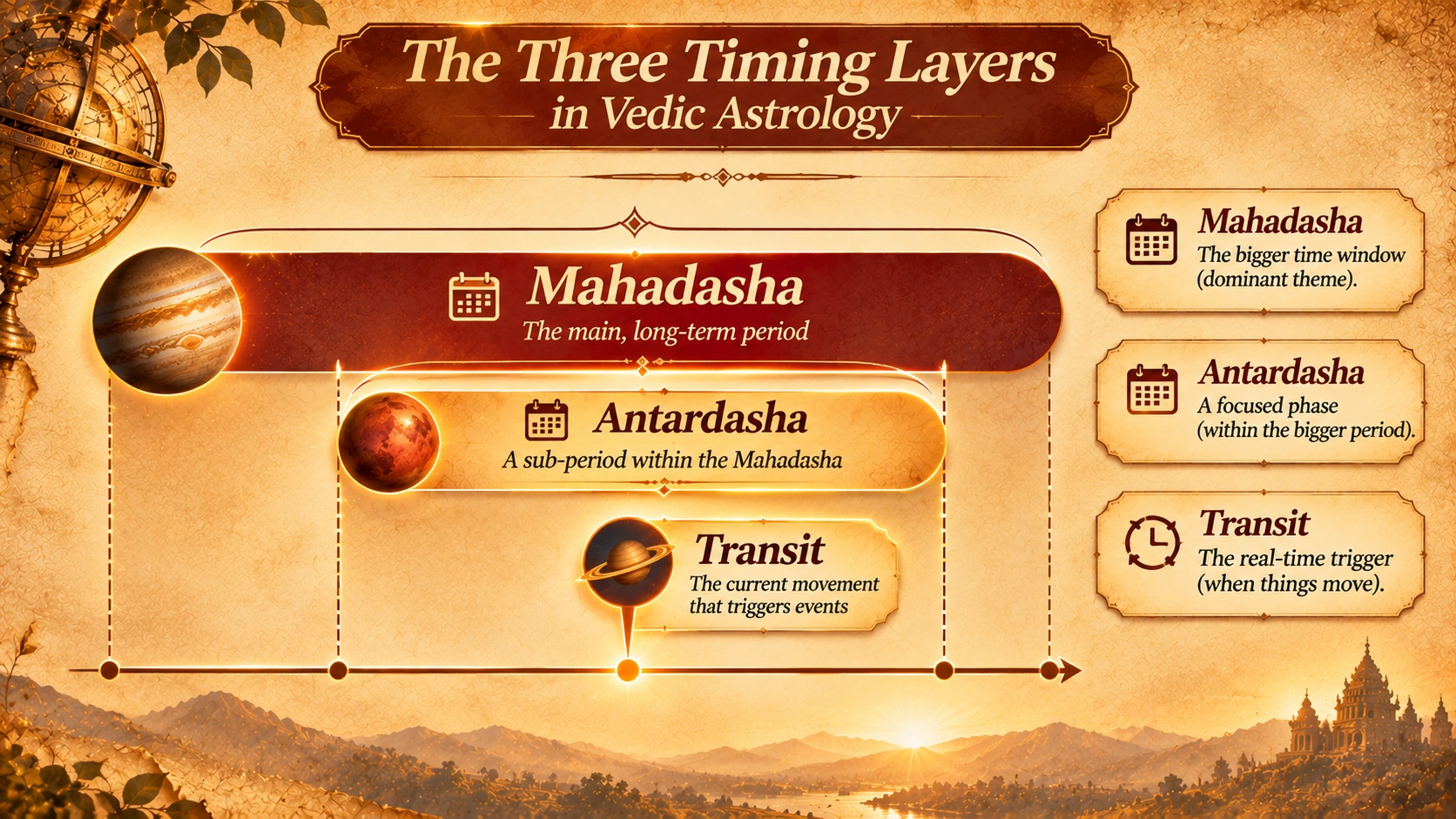
Imagine your life is a house with several rooms: career, relationships, money, family, health and personal growth.
A mahadasha is like turning on the lights in one part of the house. It brings a particular planetary theme into focus.
An antardasha is like choosing which room gets attention within that larger period.
A transit is more like the moment something moves in that room: a conversation, an opportunity, a decision or a change.
This is a simple analogy, not a literal rule. The important point is that these are different timing layers, and astrologers read them together.
For the foundations, read how to find your dasha and the dasha and antardasha. You can also read Saturn's difficult periods.
1. Is the planet capable of delivering?

A planet may be called benefic, but that is only one part of the reading.
Picture a talented employee who has been given an important project. If they have no resources, little support or too many restrictions, the project may not move smoothly.
In the same way, astrologers examine a planet's strength and condition, not just whether it is naturally considered benefic.
They may check whether the planet is:
- Exalted, in its own sign, or in a friendly sign.
- In an enemy sign or debilitated.
- Combust, retrograde or affected by other planets.
- Supported by its placement and aspects.
- Strong in measures such as Shadbala.
A benefic planet that is weak may not express its positive themes easily. A naturally challenging planet that is strong may still produce significant results, though the nature of those results depends on the full chart.
Remember: benefic or malefic describes a planet's general nature. Strength describes its capacity to act. Neither should be judged on its own.
Try this chart check: Find your mahadasha lord. Note its sign, house and dignity. Then check whether it is combust, retrograde or under pressure. If you have a Shadbala report, note that too.
2. Is the right area of life being activated?
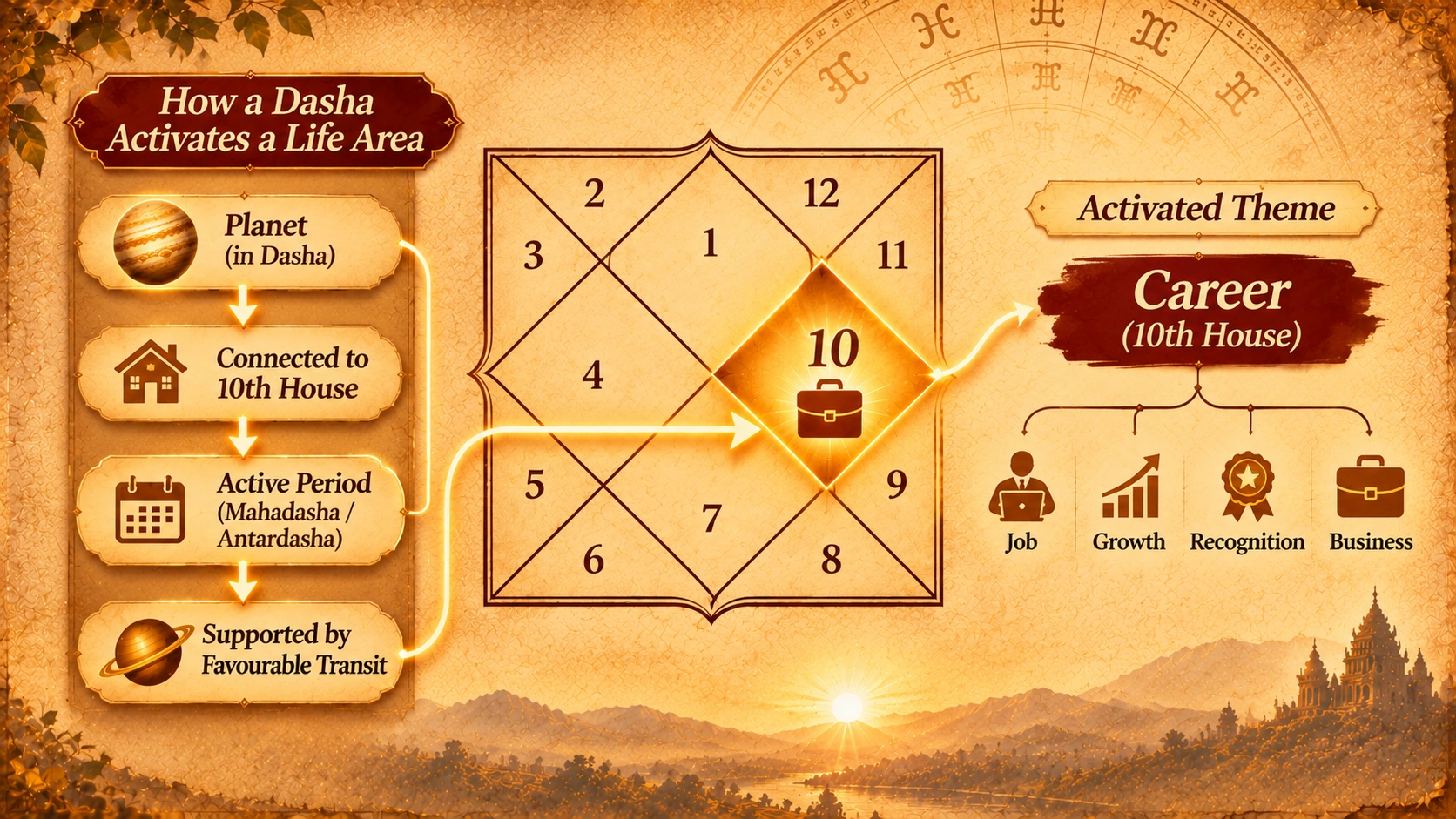
Sometimes the period is active, but not in the area you expected.
Suppose a person expects a career breakthrough. Their mahadasha lord may connect strongly with the 6th house, which is traditionally associated with service, work routines, competition and obstacles.
That period may bring more responsibility, a demanding job, competition or the need to solve workplace problems. It may not immediately look like a promotion.
The houses ruled by a planet and the house it occupies both matter.
For example:
- A connection with the 10th house can bring career and public-work themes into focus.
- A connection with the 7th house can bring partnership, marriage or business relationships into focus.
- A connection with the 4th house can bring home, property, comfort or inner stability into focus.
- Connections with the 6th, 8th or 12th houses may bring themes such as service, conflict, change, research, expenses, retreat or release.
These are broad traditional associations, not guaranteed event predictions.
Also examine whether the house itself is supported. Its lord, occupants and aspects can change how the house's themes are expressed.
The question to ask is not only “Which planet's period am I in?” but also “Which houses does this planet connect me to?”
3. Does the antardasha support the mahadasha?
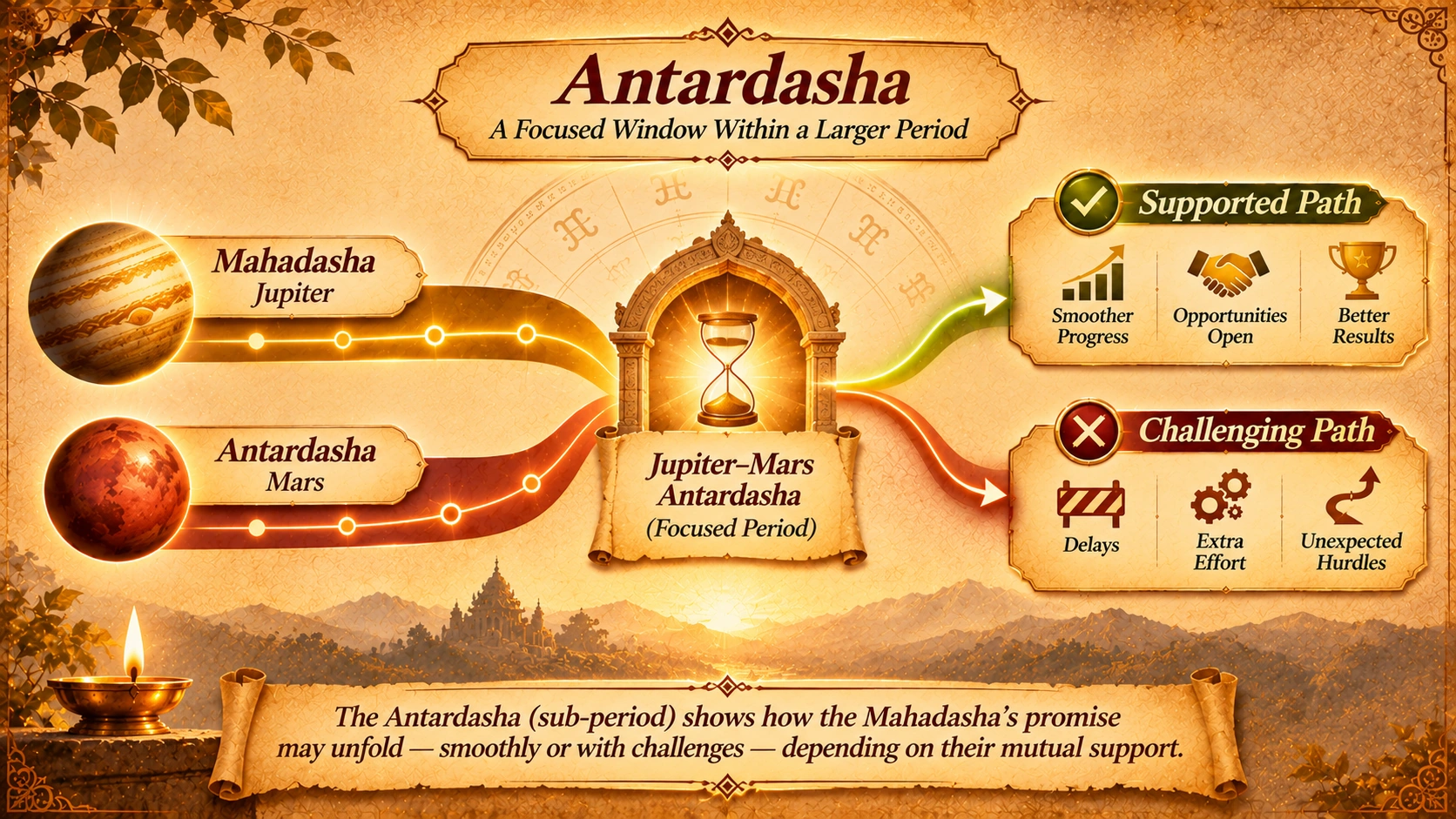
This is where the story becomes more specific.
The mahadasha sets the broad theme. The antardasha, also called the sub-period, adds another planet's influence to that theme.
You can picture the mahadasha as the main project and the antardasha as the person currently handling an important part of it. If they work well together, progress may feel smoother. If their priorities differ, the same project may involve extra effort or delays.
For example, a Jupiter mahadasha may be associated with growth, learning or expansion. During a Saturn antardasha, those themes may be experienced through discipline, responsibility, patience or delay.
That does not automatically make the combination bad. It changes the way the period may be experienced.
Astrologers examine the relationship between the two lords, the houses they rule and occupy, and their connections in the chart. A difficult relationship between the period lords can make the result less straightforward.
A practical check: Do not stop at “I am in Jupiter mahadasha.” Find the exact antardasha and its dates. Then read both planets together.
For a deeper explanation, see the dasha and antardasha.
4. Is there a transit trigger?
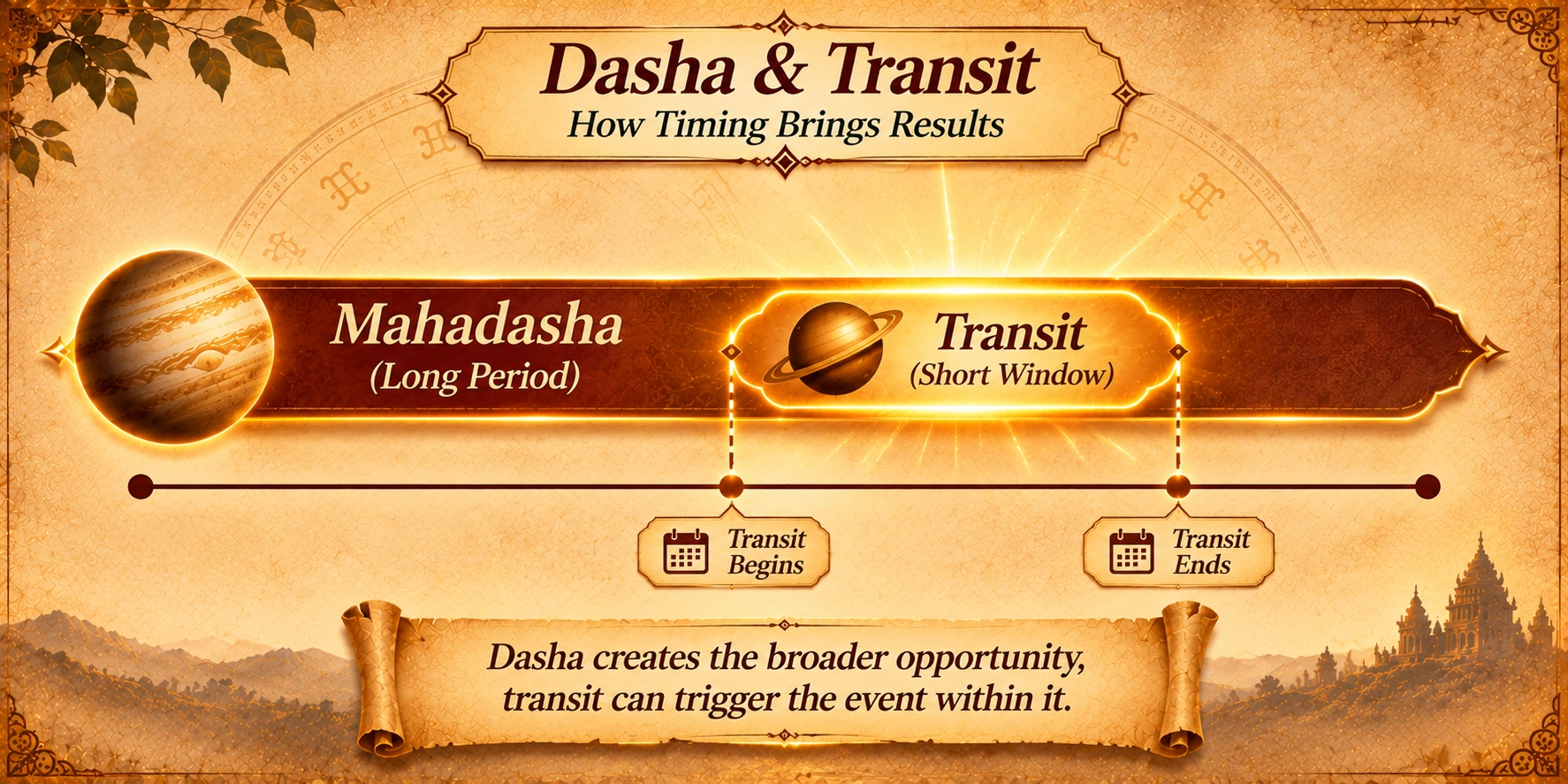
You may have the right theme and a supportive sub-period, but the expected event may still not become visible at the time you expect.
Transits add another timing layer.
Imagine a shop that is ready to open. The dasha is the permission to operate, the antardasha is the preparation, and the transit is the moment the shutters actually go up.
Astrologers commonly examine whether Jupiter, Saturn, an eclipse or the mahadasha lord's own transit connects with the relevant planet, sign or house.
For example, they may examine:
- Jupiter's transit over the mahadasha lord, its sign or a relevant house.
- Saturn's transit over the same points, often read through themes of responsibility, discipline or delay.
- Eclipses affecting a relevant house axis.
- The mahadasha lord's own movement through sensitive chart points.
A transit is a factor astrologers interpret, not a promise that a specific event will happen.
You can check current planetary transits.
5. What does ashtakavarga add to the picture?
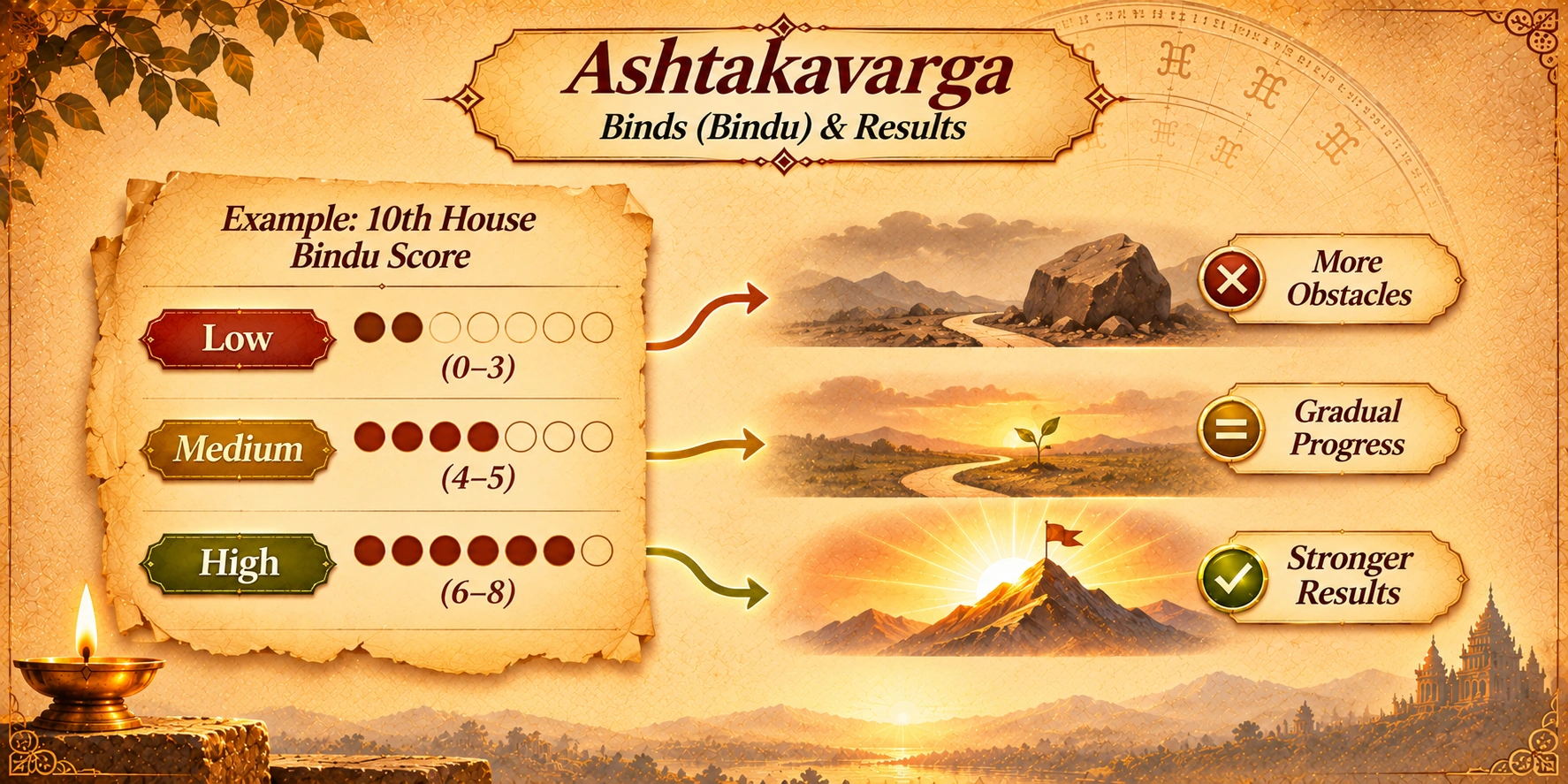
Ashtakavarga sounds complicated, but its basic idea is easier than the name.
In simple terms, it is a points-based support system used in traditional astrology to assess planetary transits through signs.
The points are called bindus.
When examining a planet's transit through a sign, astrologers may look at the relevant ashtakavarga score:
- A higher score can be read as more support for that transit.
- A lower score can be read as less support.
- The result is considered alongside the dasha, the chart and the other transit factors.
In the interpretive rule used in this article, below 4 bindus is treated as a weaker transit indication and above 4 as a stronger one. Do not treat that as a universal guarantee or a standalone prediction.
Important: Ashtakavarga is not a score for whether your entire kundli is good or bad. It is one filter used while assessing transits.
A low score does not mean nothing can happen. A high score does not guarantee an event.
Put all five checks together
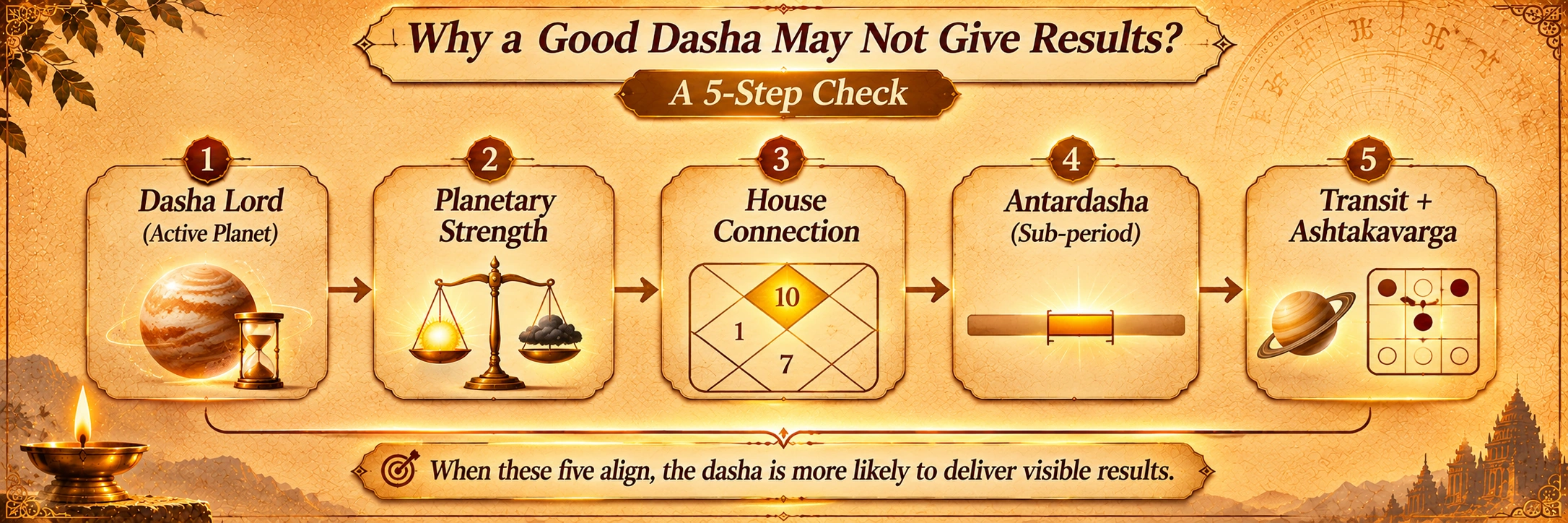
Let's take a simple example.
Someone is expecting a career change during a supposedly favourable dasha. But the opportunity keeps getting delayed.
Instead of immediately calling the period bad, an astrologer might examine the five layers:
| Check | What to ask | What it helps you understand |
|---|---|---|
| Planet strength | Is the dasha lord strong and supported? | Its capacity to express its themes |
| House activation | Which houses does it rule, occupy or influence? | Which areas of life are involved |
| Antardasha | Does the sub-period support or complicate the main period? | The tone of the current window |
| Transit | Is a relevant transit connection active? | Whether a timing trigger is present |
| Ashtakavarga | What support does the relevant transit receive? | An additional transit filter |
The point is not to find one magical answer. It is to see which part of the interpretation needs more attention.
What does an “open but empty” period feel like?
It can feel like you are close to something, but it never quite happens.
- You get interviews, but no final offer.
- A business conversation looks promising, but the deal keeps getting postponed.
- A relationship moves forward, then becomes uncertain.
- You work harder, learn more and prepare, but the visible result takes time.
In this article, “open but empty” is a simple way to describe a period where the theme seems present but the expected external event has not materialised.
It is not a classical technical label, and it does not prove that a particular layer is missing.
Most importantly, it does not mean you have a bad chart.
What can you actually do?
You do not need to panic or rush into a remedy. Start with the information required to read the period properly.
- Verify your birth time. A recorded time is more reliable than a guess. Inaccurate birth details can affect chart interpretation.
- Get the full dasha sequence. Note the mahadasha, antardasha and their start and end dates.
- Check the five layers in order. Planet strength, house activation, antardasha relationship, transit and ashtakavarga.
- Use the period constructively. Prepare, learn, build relationships and take practical action. A chart does not make the phone call or submit the application for you.
- Be careful with paid remedies. Ask what a suggested remedy is intended to address and what classical basis is being used. Do not assume that buying a gemstone can force a dasha to produce an event.
For related chart patterns, read Neechabhanga Raja Yoga and what is Kemadruma dosha.
What this explanation does and does not claim
This framework does not say that you have a bad chart, that every delay has one astrological cause, or that correcting one factor guarantees an event.
It also does not turn ashtakavarga into a score for your whole life.
The point is simpler: to show why a dasha should not be judged by its name alone, and why a responsible reading considers several factors together.
Astrology is a traditional interpretive system. These combinations should not be treated as scientifically established predictions or as a substitute for practical decisions.
Frequently asked questions
Why did a good dasha pass without results?
In traditional Vedic astrology, the dasha is read alongside planetary strength, house connections, the antardasha, transits and ashtakavarga. A favourable label alone is not enough to assess the whole period.
Does a benefic dasha always give good results?
No. A planet's natural nature is only one factor. Its strength, house ownership, placement, associations and sub-period context also matter.
Can a malefic planet give good results?
It can be capable of giving strong results when well-placed or strong, but the nature of those results depends on the full chart and the houses involved.
What is the difference between mahadasha and antardasha?
Mahadasha is the major planetary period. Antardasha is the sub-period operating within it. Astrologers interpret them together rather than treating the major period as the whole story.
Does ashtakavarga decide whether a dasha will work?
No. Ashtakavarga is one tool used to assess transit support. It does not replace the dasha analysis or guarantee an event.
Classical sources
The method discussed here draws on the following classical texts. Chapter references are provided so readers can verify the traditional framework.
- Phaladeepika, Mantreswara, translated by V. Subrahmanya Sastri (2nd ed., 1950). Adhyaya XXIII covers ashtakavarga; Adhyaya XXIV covers ashtakavarga effects; Adhyaya XX covers dashas of bhava lords and bhuktis; Adhyaya XXI covers subdivisions. Read the full text on Archive.org.
- Brihat Parashara Hora Shastra, translated by R. Santhanam. Chapters 66–70 cover ashtakavarga; chapters 27–28 cover strength and benefic/malefic tendency. Read Volume 1 on Archive.org.
Chapter references help readers locate the traditional material; they are not a substitute for interpreting an individual chart.
The honest answer: a good dasha is not a guarantee of instant results. The more useful question is not simply “Why is my dasha not working?” but “What does the complete period analysis actually show?”
Comments
Related Articles

Which Dasha Am I In? Find Your Mahadasha and Antardasha
Learn how to find your current Vimshottari Dasha from your birth Moon Nakshatra. Understand the Mahadasha sequence, calculate the balance at birth, and identify your Antardasha.

Vasi Yoga: Meaning, Formation, Effects & Benefits
Learn about Vasi Yoga in Vedic Astrology, its formation, effects on confidence, intelligence, wealth and prosperity, negative combinations, and remedies.

When Will a Difficult Period End?
Find when a tough phase may ease in your Kundli. Learn how sub-period end dates, Upachaya houses and slow transits shape a difficult dasha, without fear.